
Hall Road, Lahore: Devotion’s Signal Chain

Figure 1: The grid as canopy
Hall Road at rush hour: handset billboards, repair stalls, and a sea of motorbikes under a web of low-slung power and data lines. This is the retail face of Lahore’s electronics corridor and the front door to its repair/reuse economy.
Credit: Photo by the author, Hall Road, Lahore (Aug 2024).
BY HASSAN ASIF
Hall Road is not a street so much as a live circuit. Coils of LED strip throb under glass counters; spools of XLR and speaker wire hang like vines; the ozone of solder and hot plastic mixes with dust, diesel, and chai. Between stacks of replacement fans and boxes of Focusrite look-alikes, a salesman traces power with his finger: from wall to stabilizer to UPS to mixer to the mic that will carry a na’at (Islamic poems in praise of Prophet Muhammad) into a thousand phones by sundown. “We sell continuity,” he says - signal with just enough headroom. Read as infrastructure rather than marketplace, the scene aligns with Brian Larkin’s reminder that infrastructures are sensory and affective as much as they are technical: they organize what can be felt and heard, not just what can flow. Continuity here is not only electrical; it is devotional and social, an assurance that praise will arrive with minimal loss.
During fieldwork, I followed na’at practitioners here after studio sessions to price gear, fix an interface, or, more often, to pick up “software” on a thumb drive. The market taught me its ethics quickly: two truths held at once. One, it keeps Islamic devotional media alive, cheap, and mobile. Two, it runs on informal circulations that everyone knows are illegal. On any given afternoon, price lists are recited like litanies - microphones and studio monitors, audio interfaces and soundproofing foam - alongside whispered offers of cracked DAWs, plugin bundles, and sample libraries. If Sundaram called Delhi’s media ecologies a “pirate modernity,” Hall Road renders piracy as maintenance: the work that closes the gap between aspiration and budget. Steven Jackson’s “broken world thinking” also fits, repair is not an aftermath but the condition under which media lives. Yet there is a divergence too. Much repair scholarship foregrounds the life of objects; here, the object of care is the voice. The practical theology I encountered - making sacred voice intelligible despite budget, blackout, and bureaucracy - turns copyright breach into a contested form of pastoral care.
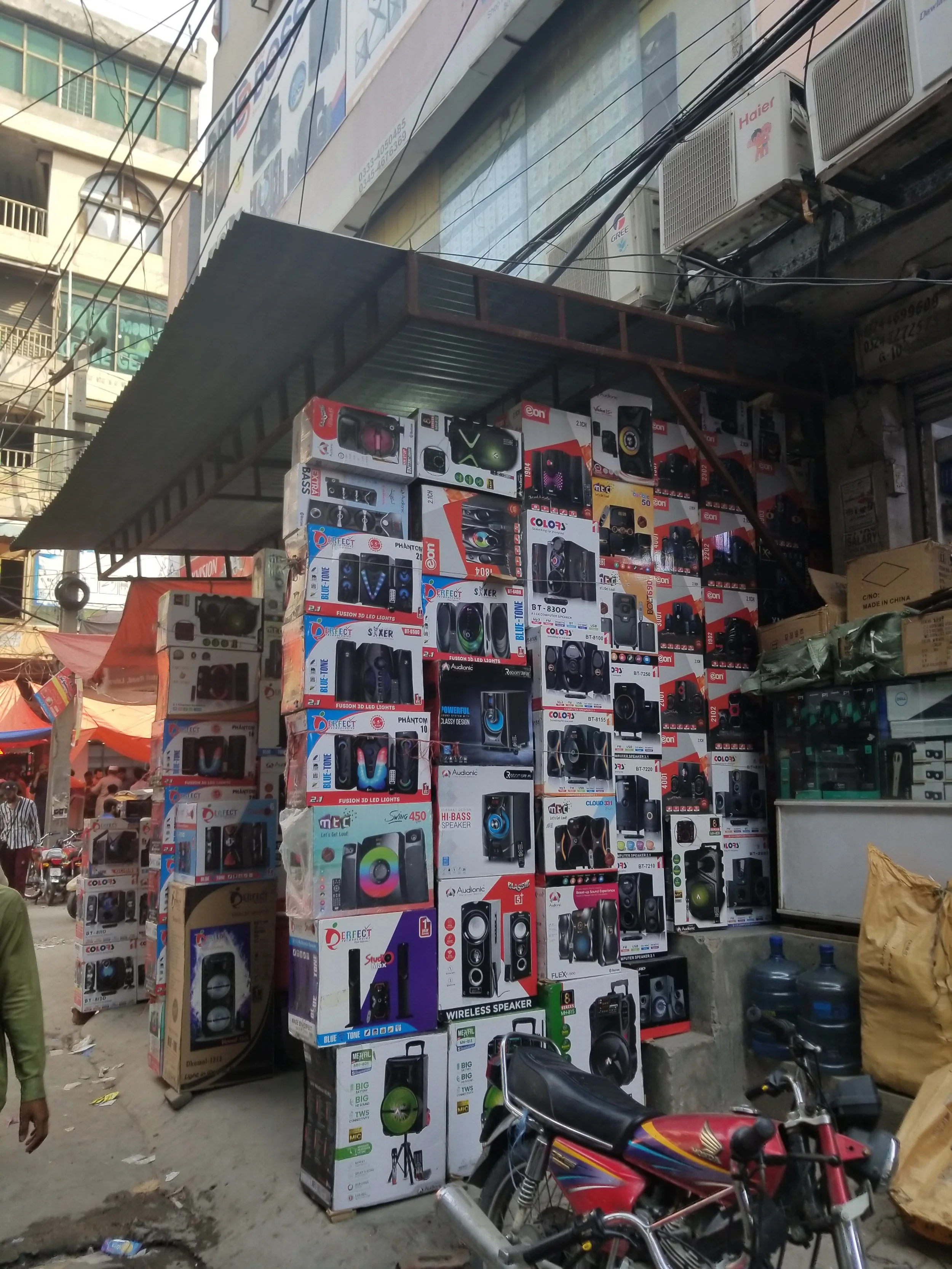
Figure 2 — Towers of sound
Stacks of boxed Bluetooth and karaoke speakers form a temporary façade on the sidewalk. The packaging promises portability and bass; the street supplies the after-sales reality: adapters, spares, and hacks to keep them running.
Credit: Photo by the author, Hall Road, Lahore (Aug 2024).
I also saw Hall Road as an index of verbs: splice, reflash, bypass, remap, borrow. A boy no older than fourteen reballs a phone GPU with a heat gun while his uncle assembles a four-channel “Mehfil Rig” - pre-wired, color-coded, packed in a steel case that will travel by rickshaw to a tented street, deliver gain before feedback, and return smelling of rosewater and sweat. On the neighboring counter, someone installs FL Studio and drops a folder named “VoX_Suite_FINAL” onto a client’s desktop. Payment is half in rupees and half in trust: “Bring the drive back if your friend needs it.” In the narrow alley behind the shop, a coil of CAT-6 is pulled through a window and trimmed with a nail clipper. Nobody calls it infrastructure, but that’s what it is. Lisa Parks and Nicole Starosielski write of “signal traffic”, the hidden relays that make circulation plausible. Hall Road is that traffic made public: a relay made legible at human scale. What looks like petty improvisation is, on inspection, a vernacular theory of latency, redundancy, and risk.
Even when you start the signal chain further upstream such as a primetime religious television broadcast during Ramadan or a foam-padded na’at recording room in Johar Town, Hall Road still sits in the graph as the node of last resort. A plugin refuses to authorize; a cracked DAW stutters at low latency; someone says, “Bas Hall Road jao.” Go there; they will solve it. The technicians work in half-prayer, half-hack idioms, slipping between invocations and driver updates. To watch them is to see an informal HCI lab: hypothesis, patch, listen; repeat until the noise floor behaves. One favorite ask is “eeco,” the affectionate mispronunciation of echo: a preset that lets a lone voice carry its own walls, beloved by reciters who want presence in a square with no acoustics. If Hirschkind traced moral audition through cassette sermons, Hall Road updates the argument in DSP: the norm is now encoded in presets. Here, governance happens as parameter - pre-delay, decay, cut-off - long before any cleric or platform moderator hears the track.
People call Hall Road a “market for electronics.” True, but flat. It is also a public school for sound. I watched salesmen teach reciters to read meters, to stop chasing loudness with gain, to trust a high-pass against proximity boom. I watched them rewire dimmers so a stage would not hum on 50 Hz, and label cables for a teenager who would tear down at 3 a.m. before Fajr prayer. In that sense, Hall Road extends both studio and seminary. Shannon Mattern has urged us to see maintenance and pedagogy as infrastructural labors; the tutorials I witnessed were exactly that - care rendered as repeatable technique. The divergence from digital religion writing that centers platforms is also instructive: while much scholarship follows how believers assemble online, the assembly I saw was literal: bananas, jacks, ferrules, and the moral tact of saying “enough reverb” when the mix flatters piety into performance.
Hall Road has weather. Load-shedding makes the street pulse. When the utility browns out, generators cough awake and a wave of power supplies squeals through its boot sequence; for a moment the whole market becomes a synthesizer: fans rise into pitch, UPS units peep in canon, fluorescent starters snap like snare drums. A shopkeeper touches a transformer case with the back of his fingers to judge burn. Another drapes a wet cloth over a rackmount because airflow is blocked by a tower of cartons. Electricity is not a background condition here; it is a character in every scene. Environmental media, in this register, is not landscape but impedance. Jennifer Gabrys writes of “digital rubbish”; Hall Road shows a parallel category: digital residue that can be coaxed back into service. Dead routers, spent LEDs, broken PTZ domes, and blasted woofer cones become inventory; toxicity, thrift, and devotion share a bench and a glass of chai. The analysis this invites cuts both ways: reuse reduces waste and also entrenches exposure - lead in solder, brominated dust in lungs. Salvage and sacrifice mix.
From the perspective of the city, Hall Road is a pressure valve that turns scarcity into signal. Foreign currency tumbles; import duties jump; a flood knocks out a substation; the dollar price of a condenser mic doubles; or a broadcast memo lands about the proper style of televised praise. And still the mehfil happens. Engineers here design for failure: expect brownouts, pack extra TRS-to-XLR adapters, avoid the show-killer plugin, keep a backup USB with the “safe” chain. Resilience is not a slogan; it is an inventory. The term “resilience” is often celebrated in policy documents; on Hall Road it reads differently: as a cost borne by those who patch around state and supply-chain volatility. The preparedness I saw is admirable and also a ledger of abandonment. To praise resilience without naming the structures that require it is to mistake endurance for justice.
But resilience is never neutral. The same circuits that keep devotion audible also normalize gray infrastructures: kunda lines that steal electricity; copied software that collapses the line between survival and theft; DIY acoustic treatment made from foam that will choke a lane when it burns. Moral economy, not market price, often sets the threshold. When I write that Hall Road is a live circuit, I also mean a moral one. The current is continuous and contested. Sellers and buyers narrate their compromises without euphemism: “Genuine would be best; Allah be my witness; but the show is tonight.” Digital-religion scholarship often parses belief through interfaces and feeds; Hall Road compels us to add meters and mains. The ethics here are hands-on: grounded in transformer heat, not only in terms of service.
For na’at reciters I walked with, none of this is abstract. A console is a thousand tiny norms rendered as knobs. A preset is a frozen argument about presence. A USB stick full of plugins is a bag of futures. On the walk back to the Orange line metro, the repair stalls are still open at midnight, bright with desk lamps and surrounded by the day’s broken promises. The next morning’s mehfil will bring those promises to a microphone in a garden, a lane, a mosque courtyard; hands will rise, and an engineer - maybe fifteen, maybe fifty - will ease the fader up until the voice clears the bustle and lands in a chest. If much-writing on such media prioritizes platform logics, Hall Road asks us to begin before the upload: with the capacitors and compromises that make the file exportable at all. Here, environmental media stops being metaphor. Electricity becomes the weather. Toxicity is texture. Waste is workflow. Repair is pedagogy. Piracy is policy by other means. And devotion - love as practiced signal - must pass through all of it on the way to the ear. The market is famous for electronics and infamous for software; both facts are true, and both sustain the sound of praise in a city that refuses silence.
Works Cited
Gabrys, J. (2011). Digital rubbish: A natural history of electronics. University of Michigan Press.
Hirschkind, C. (2006). The ethical soundscape: Cassette sermons and Islamic counterpublics. Columbia University Press.
Jackson, S. J. (2014). Rethinking repair. In T. Gillespie, P. J. Boczkowski, & K. A. Foot (Eds.), Media technologies: Essays on communication, materiality, and society. MIT Press.
Larkin, B. (2013). The politics and poetics of infrastructure. Annual Review of Anthropology, 42, 327–343.
Mattern, S. (2018). Maintenance and care. Places Journal.
Parks, L., & Starosielski, N. (Eds.). (2015). Signal traffic: Critical studies of media infrastructures. University of Illinois Press.
Sundaram, R. (2010). Pirate modernity: Delhi’s media urbanism. Routledge.
Hassan Asif is a PhD candidate at the University of Toronto’s Faculty of Information. His work sits at the intersection of digital religion, devotional media, and platform studies. In his doctoral project, he follows the production of religious devotion across pirate electronic markets, home studios, television control rooms, and WhatsApp workflows to show how sacred voices are tuned, circulated, and governed. He has served as a Senior Digital Fellow with the Muslims in Canada Archives and teaches on digital platforms, media remix, and popular religion.