
“We Won’t Be Hungry Much Longer”: Reading Madness and Feminine Rage on Yellowjackets
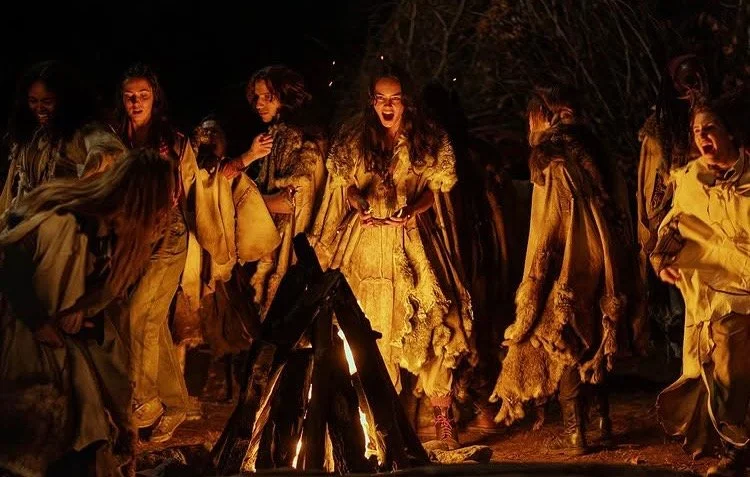
Yellowjackets, "Full Circle." Season 3 Episode 6 https://www.instagram.com/p/DHTnocMJ73D/?img_index=1, Courtney Eaton as teenage Lottie in the 1990s timeline
BY MARGARET CALDERON
The links between madness and spirituality have calcified into cultural tropes about clairvoyance and second sight that run the gamut from philosophy to primetime television. The madwoman or sick woman is an especially contested, remixed and reclaimed figure (Hedva 2022). Yellowjackets (2022-ongoing) is an ensemble mystery series that tells the story of a high school soccer team who are left stranded in the wilderness after their plane crashes on the way from New Jersey to Seattle for a tournament. Over the course of three seasons, the drama shifts between the 1990s timeline and the present-day, during which a handful of survivors are reckoning with the legacies of what they went through during the eighteen months between the crash and their eventual rescue. Yellowjackets’ depiction of what LaMarr Jurelle Bruce calls phenomenal madness plays into racial stereotypes by casting the character Lottie (played by Māori actresses Courtney Eaton and Simone Kessell) as a seer who possesses unique insights which, pathologized in her everyday life, distinguish her as a leader in the forest. Though troubling, this characterization resists vulgar conceptions of the body as a medium for spiritual/psychic experience by insisting on the complexity of Lottie’s experience and the web of signifying practices she inspires amongst her teammates.
The show is a window into the complex and tenuous relationships between feminism, cripistemologies (Johnson and McRuer 2014) and settler colonial depictions of neurodivergence as it relates to spirituality. Described as giving voice to the “deep well of female fury” (Mitchell et. al. 2024, 126) associated with the period from the mid-2010s to 2020s, the show gained a cult following, fuelling an abundance of fan theories about the ritualistic sacrifices hinted at in its pilot episode. The ostensible cannibal cult leader whose identity is hinted at but remains a mystery is a key point of speculation in the show’s fandom. By centring Lottie’s narrative, the show’s reductive framing of madness becomes an entry point into uneasy convergences that are often glossed over within the media iconography of third-wave feminism.
While staking out an engaging and challenging space for female antiheroes and complex women characters on primetime TV, Yellowjackets highlights the entanglement of spirituality with more sinister aspects of human nature by using disability as a foil through Lottie’s characterization. In the world of Yellowjackets, psychiatric disability is inextricable from shifting narratives surrounding gender, psychosocial affective economies and feminine rage. Though the satisfaction of female fury maps out differently according to each character on the show, Lottie’s proximity to the figure of the cult leader/shaman is collapsed, making her a focal point of the show’s supernatural themes. This may be a red herring to set up shocking revelations for next season’s arc, but it nevertheless engages racialized stereotypes surrounding psychiatric disability that warrant scrutiny.
In Brilliant Imperfection: Grappling with Cure, Eli Clare articulates a resounding refusal of the appropriation of Indigenous cultures within new age spirituality, a form of dehumanization that goes hand in hand with its ableism:
In that split second, racism and ableism tumbled into each other yet again, the entitlement that leads white people to co-opt Indigenous spiritualities tangling into the ableist stereotypes that bestow disabled people with spiritual qualities. She whispered in my ear that if I were trained, I could become a great healer, directing me never to forget my specialness. Oh, how special disabled people are: we have special education, special needs, special spiritual abilities. That word drips condescension (Clare 2017, 6).
How does rejecting the ableist notion of being “special” interact with conflicting understandings of illness among disabled people?
While Lottie conceals her disability in her everyday life, in the woods her visions and hallucinations are taken up by some of her teammates as prophesying their best means for survival. Her dynamic with her teammates falls squarely into Clare’s figure of the supercrip, a story which, he writes, “[relies] upon the perception that disability and achievement contradict each other and that any disabled person who overcomes this contradiction is heroic” (Clare 2015, 8). Lottie’s capacity for leadership, which may have been latent in suburban New Jersey but comes to the forefront in the woods, is reified as something mysterious and otherworldly, along with her disability. Being perceived as exceptional for having insight into ways to increase the team’s morale in the woods because of her disability creates a feedback loop about what Lottie’s contribution to the microsociety should be.
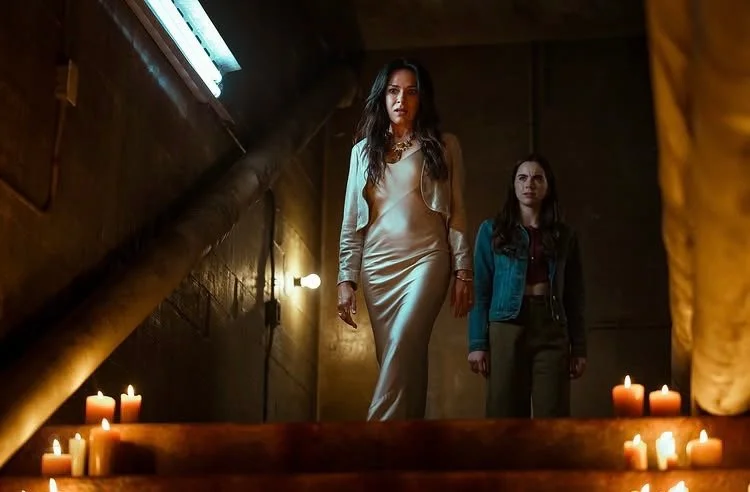
Yellowjackets, "Thanksgiving (Canada)." Season 3 Episode 10 https://www.instagram.com/p/DIcR46dphJ_/?img_index=2, Simone Kessell as adult Lottie in the contemporary timeline
As Lottie’s characterization exemplifies, psychiatric disability is a boundary object that articulates the limits of staid conceptions of reason and rational thought. In order to think beyond the framework of inclusion/exclusion implicit in this framework, it is imperative to remap the ostensible limits of feminist, decolonial and disabled solidarity. In Native Americans and the Christian Right, Andrea Smith argues that central to the modes of rural indigenous activism she analyzes is the intentional refusal to make assumptions about who one’s allies might be in opposing exploitative, extractive industrial practices. Mad/disabled thought would do well to draw from strategic coalitions that open up the potential to reduce the burden of stigma accrued to madness and target the marginalization and mistreatment of those with psychiatric disabilities using a multivalent approach.
Within mad studies, there is an enduring stereotype about the creative gifts bestowed to artists labelled as bipolar, from Virginia Woolf to Beethoven. This is not necessarily a negative thing. Kay Jamison, a clinical psychologist, who has bipolar disorder, wrote a book about the creative temperament that goes along with the illness, Touched with Fire (1996), a gesture of reclamation in spite of its reliance on the controversial practice of retrodiagnoses (Lewis 2009). Following Clare, I contend that stereotypes about spiritual and creative gifts that come along with disablement are at their most harmful when imposed from without.
Whether Yellowjackets’ treatment of Lottie represents a mere synthesis of these tropes or the development of a feminist perspective is nebulous. During Lottie’s time in the woods, her teammates draw from their perception of her as having diverged from reason to construct a provisional morality that lends meaning to their desperate quest for survival. Bruce writes that “unReason entails moral deficiency and ineptitude. (This is why throes of passion, flights of fantasy, and bouts of madness are thought inimical to one’s moral sense)” (4). In the Yellowjackets’ wilderness, it is this same quality that gives Lottie’s teammates a greater hope for survival. Lottie’s phenomenal madness is framed as being commensurate with her prophetic visions, a treatment that belies its bias in granting her character humanity foremostly through her apparent performance of extrasensory perception.
Turning to religious and spiritual dimensions of psychiatric disability is an important avenue for grasping the conditions that shape our cultural perceptions of madness. Yellowjackets’ depictions of mentally ill mysticism, including racial tropes and feminist interjections, open onto ways of mapping the convergence of religious, feminist and (de)colonial and disability justice-informed approaches to madness. Though Lottie’s depiction as an “ad-hoc cult leader” for the girls is regressive, it raises the question of what insights a disabled person can offer to ableist society, rather than the reverse (Wang, 2019, 25). The sensational treatment of Lottie’s difference is a notable failure of the series, yet its collapsing of feminine rage and psychiatric illness hits major pressure points within contemporary feminist thought that are worth revisiting.
Prompts:
How can we think about the concept of “feminine rage” or psychosocial madness through a disability-inclusive lens? What is potentially helpful about Yellowjackets in its collapsing of phenomenal madness and psychosocial madness? What other cultural documents might we think of that speak to these overlapping experiences?
Is it inherently dehumanizing to talk about the utility of madness, and does it matter where these framings come from and the knowledge claims they make about disabled people?