
Apollo, Artemis, Satellite Blackout: The Techno-Politics of World Picturing
BY TRACY VALCOURT
For a brief period in early April of 2026, media attention was cosmically transfixed as spectators followed the crew of the Orion spacecraft on its much-anticipated journey into outer space. The first crewed lunar flyby in 50 years, the Artemis II mission was deemed historic for its pioneering achievements as the most significant continuation of deep space exploration since 1972. Propelled by the largest ever rockets, the Orion was bringing humans to the farthest distance from Earth to date.1 Also historic was the mission’s extensive mediatization, as live video feeds beamed glimpses of the claustrophobic existence aboard the spacecraft as the cheery crew reported on official accomplishments, while rapturously recounting the thrill of outer space and the minutiae of gravity-free daily life. Regular recap video clips released by NASA, featured narrated simulations of the spacecraft’s technical milestones and stunning photographic captures of the speckled expanse of deep space, while on NASA’s website, enthusiasts were treated to the mission’s multi-media array, including an app, live video available on four different major platforms, a podcast, blog, audio, and mobile wallpaper. For the duration of Orion’s voyage, Artemis II-related footage dominated every modality of American news broadcasting, eclipsing coverage of the other leading news story of the moment—the Iran War.
At the time of Orion’s lift-off on April 1, the war, whose opening salvo took place on February 28, 2026, was going on its fifth week. On the first day of the conflict, the Supreme Leader Ayatollah Ali Khamenei and members of his family were assassinated in Tehran by a U.S. precision airstrike; on the morning of this same day, at least 157 people were killed—most of them children—after two alleged U.S. Tomahawk missiles hit the Shajara Tayyiba elementary school and adjacent medical clinic in Minab, Iran.2
Dubbed Operation Epic Fury by the U.S. and Operation Roaring Lion by Israel, this joint military campaign also held a historic status in laying claim to an estimated 4,000 targets struck in the first four days of bombing Iran.3 These statistics made for a record number of sites targeted in the first days of bombing, surpassing all other recent US military incursions.4 A comparative analysis by the UK organization Airwars, which drew from publicly available targeting figures from both American and Israeli sources, found that the initial days of Epic Fury even exceeded the opening days of Israel’s bombardment of Gaza in terms of the number of targets hit.5
If the rapture of the Artemis II mission was seated in the weightlessness of the human body claustrophobically contained in the outer reaches of space, the mechanics of and response to the war in Iran was driven by earthly gravity. Just as the number of targets hit by aerial means during the conflict’s commencement was remarkable, so was the intensity of the American public’s disapproval of Trump’s decision to start the war. In its early days, public opinion was more negative than that of the late stages of the War in Vietnam, and going into the Midterm cycle, polled lower than did the Iraq War in 2006, three years after it began.6 Figuring prominently within the critical media coverage of the war was an ethical questioning of the use of AI, notably Claude, in the generation of targets and its contribution to mass civilian casualties.
A highly publicized event that celebrated American technological innovation and touted universalism by way of the space program was a welcome distraction from an unpopular and poorly orchestrated high-tech military campaign in the Middle East. Taking place during what NASA refers to as “the Golden Age of innovation and exploration” the Artemis II media promotion hinged on a strain of universalism reserved for space exploration, which advances space travel by a select few as a unifying force of all humankind. American media outlets repeated a contemporary universalist framing that leveraged the “good vibes” of the crew’s obvious chemistry to cheerfully promote a monolithic Western worldview that assumed that the global human population was equally positioned to rejoice in the achievements of the American space program.
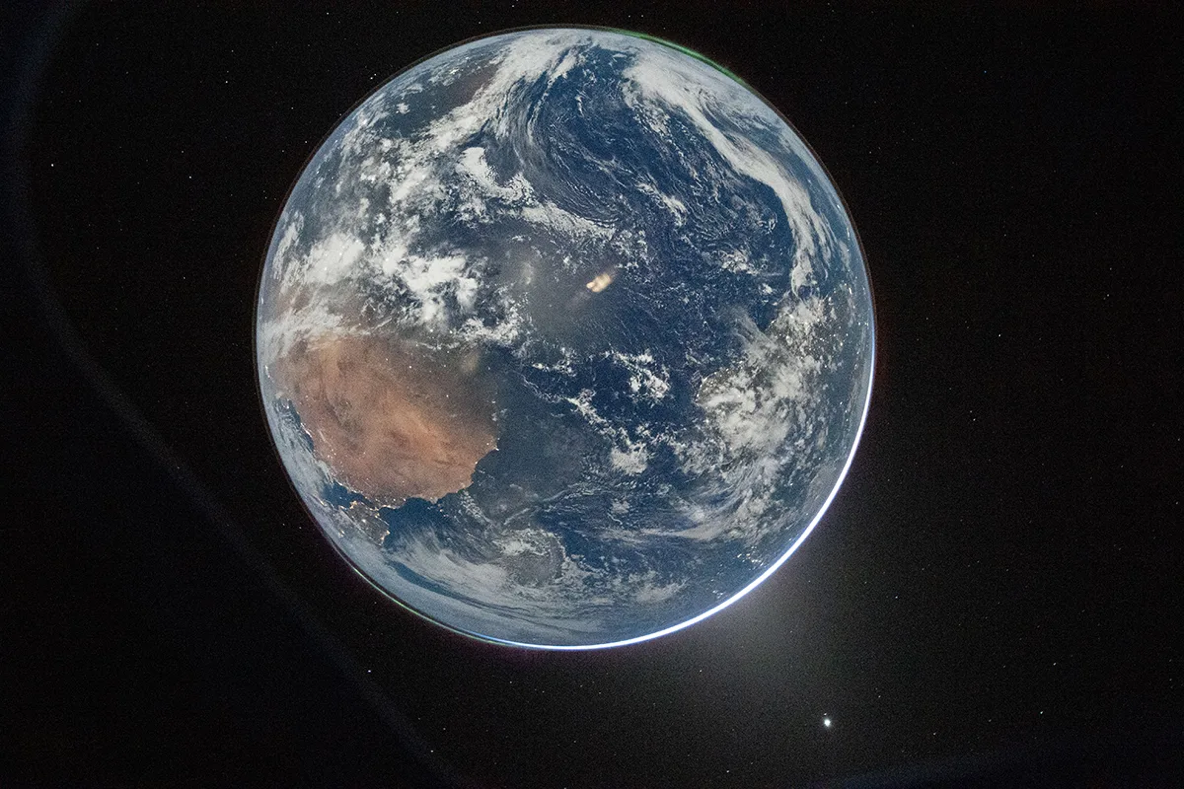
While the media narrative drew on heroic tropes and hyperbole to cultivate a semblance of worldwide excitement that was in reality only experienced by select locations and demographics of the globe, the most powerful fomenting of spatial rapture and universalist sentiment was by way of imagery. A range of images was disseminated during the flight, from spectacular “whole Earth” shots to lunar landscapes, to intimate portraits of the crew (Figs 1-3). While these photographs were impressive for their content and quality, and served as evidence of America’s engineering progress, their true potency was yoked to the curated visual culture of past space missions, with their most symbolic significance conjured in the echo of the “whole Earth” photographs of the Apollo missions. The novel iteration of these images disseminated during and after the Orion’s voyage ignited public imaginaries and reinvigorated a cultural nostalgia for the iconic photographs Earthrise, 1968 (Fig. 4) and Blue Marble, 1972 (Fig.5), captured during the Apollo 8 and 17 missions, respectively.
During the Apollo 8 mission, the visual power of Earthrise was heavily leveraged by American media to amplify the epic narrative of the mission, thereby redirecting public attention from the multitude of graphic pictures depicting earthbound tragedies of a dark period in world history (Figs. 6-8). Largely thanks to this photograph, the Apollo 8 mission earned the title of “news story of the year” by American newspaper editors, eclipsing the reportage of the riots, wars, and assassinations that plagued 1968 on a global scale. The image, as the public came to know it, displayed the upper hemisphere of the earth as a mottled dome of blue and white radiant in absolute blackness, its compositional perfection troubled by the roughness of the grey lunar surface running in a horizontal plane in the foreground below. When captured by astronaut William Anders, the photograph was composed such that the moon’s surface ran vertically along the right margin. After the crew returned to earth, NASA rotated the image 90 degrees before releasing it to the public so that the moon’s surface formed a horizon line in adherence to the conventions of the Western landscape tradition, knowing that this composition would be more legible to its target audience.7
NASA also compositionally reconfigured Blue Marble, one of the most frequently reproduced images in history. Originally taken with Antarctica positioned at the top, NASA rotated the colour photograph 180 degrees before publicly disseminating the perception of Earth “as it really is.”8 Certain of the Artemis II images bore intentional compositional resemblance to their “whole Earth” predecessors (Earthrise’s contemporary twin was titled Earthset) and thus contained vestiges of the orientational alterations of the originals and the intent behind them. Such gestures, although unknown to most viewers of the images at the time, revealed the precarious concept of “photographic truth,” highlighting the multifarious processes and opportunities for manipulation in the “production of truth” -- from the capturing of an image to its public dissemination and interpretation. Seen from today, NASA’s rotation of the photos could be considered a pioneering attempt at “shallow fakes” and a harbinger of Google Earth’s short-lived Nano Banana AI feature that allowed users to manipulate satellite imagery.9
The Artemis images also shared similarities to the “whole Earth” images via the fraught geopolitical context that surrounded their dissemination, their highly curated mediatization, and the role they played in countering negative public opinion. Earthrise, for instance, was publicly released on Christmas Eve of 1968 and promoted as a balm to soothe the collective psychic wounds amassed during a notoriously violent year that saw, for example, the assassinations of Martin Luther King Jr. and Robert F. Kennedy, an increasingly unpopular and deadly war in Vietnam, and protests on an international scale. On this night, one of the largest audiences in television history to date had gathered to watch a live telecast of the moon’s surface as seen from Apollo 8 – this novel lunar view and the revelation of Earthrise were delivered to them accompanied by a live reading from the Book of Genesis by the Apollo 8 crew members. This mass-mediatized production, including its timing on Christmas Eve, platformed a universalist narrative from a Western conception, merging the religious conception of “heaven” with the “overview effect,” a psychological state in which astronauts report “overwhelming emotions and feelings of identification with humankind and the planet as a whole.”10 Earthrise was the enduring souvenir of the pseudo-sacred moment, whose potency could be plumbed long after the splashdown of the spacecraft.
Made possible through an unscheduled confluence of events and improvised teamwork, Earthrise came to be recognized as potentially the most important accomplishment of the Apollo 8 mission. Its ability to shift a generalized negative public opinion to one of excitement endowed the astronauts with a heroic status, with one notable civilian telegram reading 'Congratulations to the crew of Apollo 8. You saved 1968.”11 Publicizing the image near the year’s end intensified its supposed spiritual and celebratory resonance as Earthrise offered the symbolic promise of a more peaceful world and served as an accelerator of cultural amnesia that suggested the past was behind us. The sentiment was encapsulated in-flight by Anders, who, intoxicated by the overview effect, lamented: “why can’t we all just get along?” Decades later, the Artemis II crew members filled a similar role, and were referred to by some on social media as their “emotional support astronauts,” on whom people came to depend as a means of coping with, for example, the conjoined horrors of 2026, including Gestapo-style ICE arrests, pop-up concentration camps, the gutting of USAID, genocide, and another U.S.-fabricated invasion in the Middle East.
Arriving in 2026, it seems “we” are not all “getting along” any better than we were in 1968. While the U.S. again demonstrated its power through world picturing during the Artemis II mission, as it had when the crew of Apollo 8 declared “let there be light,” it simultaneously flexed its optical dominion through world darkening via the war on Iran. On April 4 (Day 4 of the Artemis II mission), Planet Labs, originally founded by former NASA scientists, acquiesced to the Trump administration’s demand for an “indefinite withhold of imagery” of Iran and the “Middle East region of conflict” retroactive to March 9, 2026.12 The justification of the restriction was that the imagery could be used by Iran to target US troops or allied infrastructure in the Gulf, a claim that was discredited by research that failed to reveal that Iran used satellite imagery from US vendors, having other sources at their disposal. Industry experts, such as Bill Greer, co-founder of Common Space, a nonprofit satellite initiative, feels that Planet Lab’s restriction of the images represents a growing trend in the reduction of publicly available satellite imagery, causing them to become even more politicized. Greer argues that a major consequence of the public’s reduced access to satellite imagery, which also applies to human rights investigators and journalists, is a “reduction in the transparency of events that impact the public at a literal global scale.” For instance, satellite imagery was instrumental in confirming the Tomahawk missile strike on the school in Minab, and has been key to charting Israel’s massive destruction of Gaza, a region that has a long history of governance by exceptional politics of resolution. It seems that if anything, advances and increases in world picturing seem to inspire the inverse of global unity. Through tactics of exposure and obfuscation, those with technopolitical power transform the poetic collective vision of Earth into militarized scopic views that fracture the world’s wholeness into a multitude of targets.
Fig. 1) Photo of Earth taken by Reid Wiseman/NASA from the window of the Orion spacecraft on April 2, 2026, moments after the engine burn completion to send the spacecraft out of Earth’s orbit and on course for the Moon. This and another similar composition were the first two downlinked images from the Artemis II astronauts. Image Credit: Reid Wiseman/NASA; Image Source: https://www.nasa.gov/image-article/hello-world/
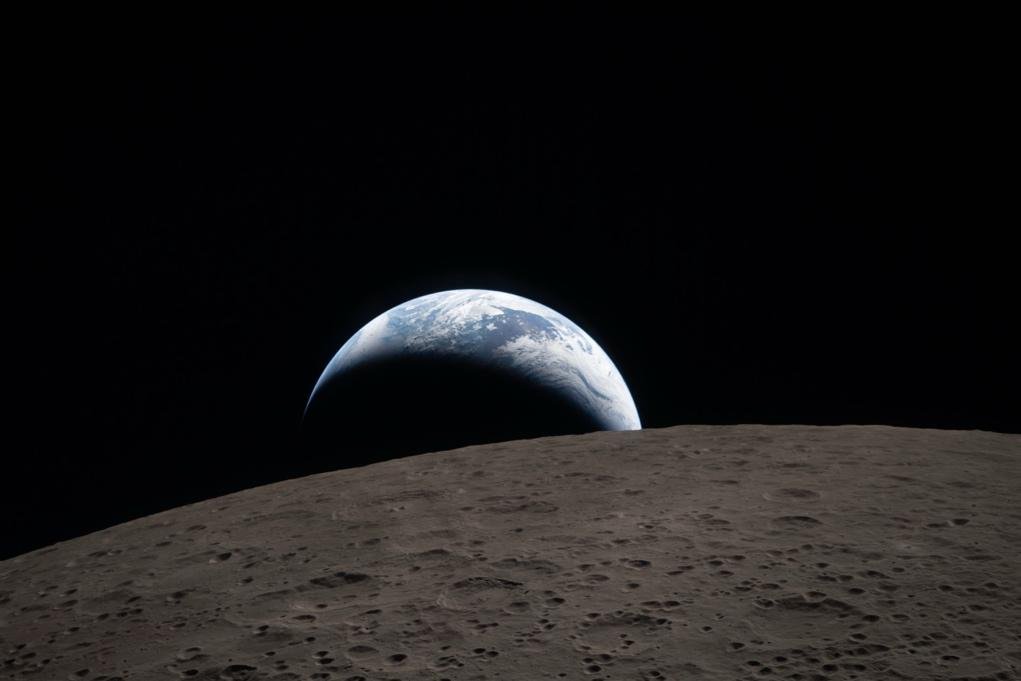
Fig. 2) Earthset. Captured through the window of the Orion at 6:41PM EDT on April 6, 2026, during the Artemis II crew’s flyby of the moon. Credit: NASA; Image Source:
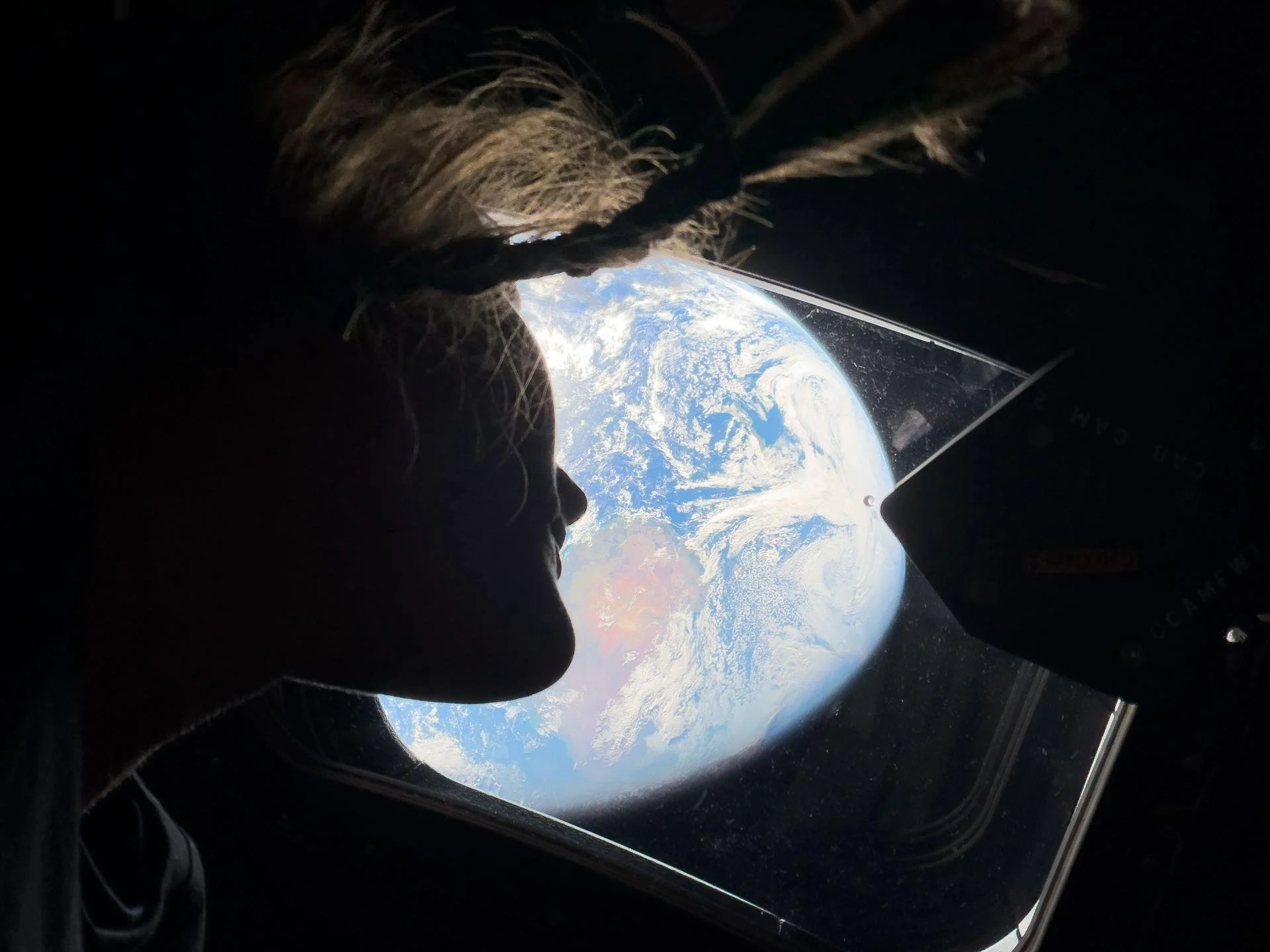
Fig. 3) The profile of NASA astronaut and Artemis II mission specialist Christina Koch as she looks at Earth from the window of the Orion on it journey to the Moon. At the time of the photo’s capture, Koch was already farther away than any woman had been from Earth. Image Credit: NASA; Image Source: https://www.planetary.org/space-images/christina-koch-views-earth-from-orion
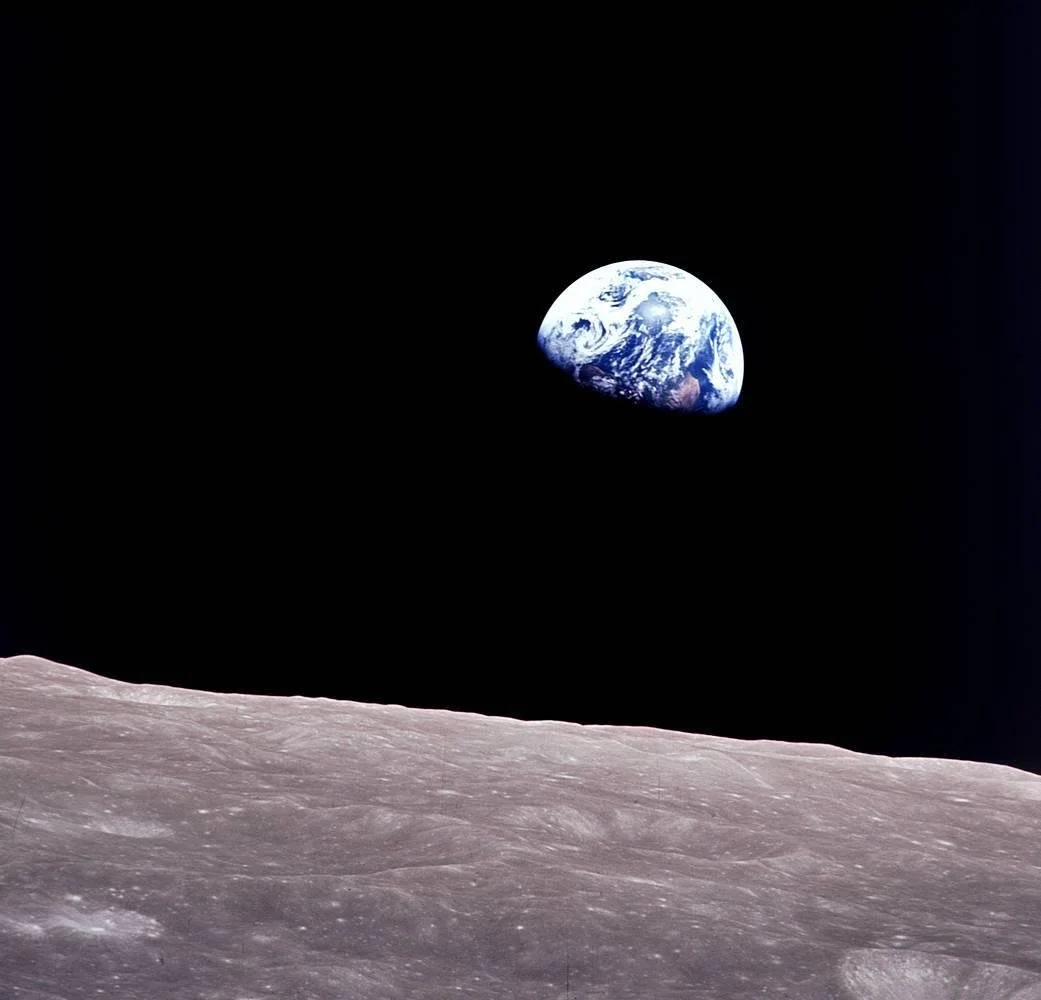
Fig.4) Earthrise (1968) taken by Apollo 8 astronaut Will Anders. Image Credit: NASA; Image Source: https://www.nasa.gov/image-article/apollo-8-earthrise/

Fig. 5) View of the Earth as seen by the Apollo 17 crew traveling toward the moon. Taken December 7, 1972, this NASA image has come to be known as The Blue Marble. Image Credit: NASA; Image Source: https://www.nasa.gov/image-article/apollo-17-blue-marble/
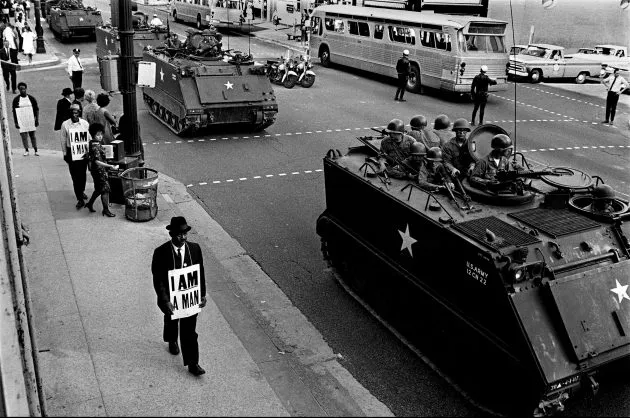
Fig. 6) A man marches alongside a tank during the sanitation strike in Memphis on March 29, 1968. Photo Credit: Barney Sellers/ZUMA; Image Source: https://www.motherjones.com/politics/2018/03/memphis-sanitation-strike-martin-luther-king-assassination/
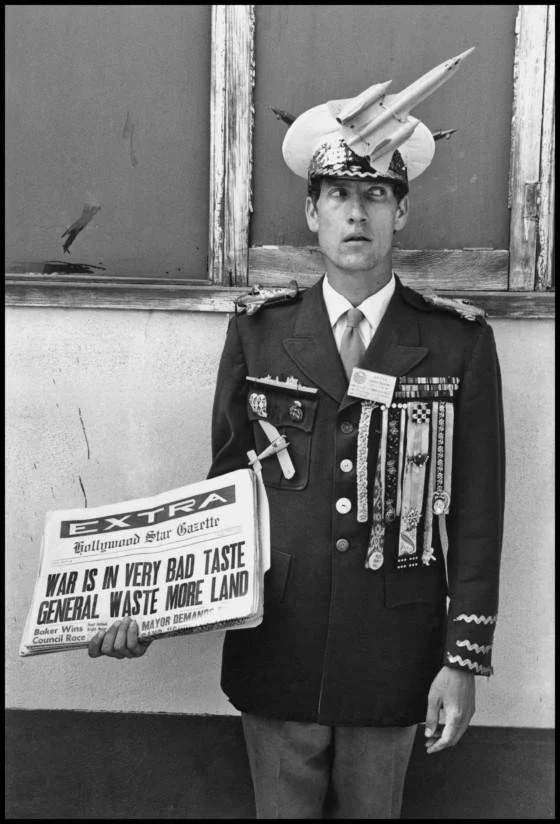
Fig.7) Pacifist demonstrating at Santa Monica. "Waste more land" alludes to the name of the US Commander-in-Chief in Vietnam, General Westmoreland. California. 1968. © Dennis Stock | Magnum Photos; Image Source: https://www.magnumphotos.com/newsroom/politics/1968-power-protest-politics/?_gl=1*i256g8*_up*MQ..*_ga*NTc1MDA3ODI4LjE3ODg2MzM3NzM.*_ga_50D0ZG80LT*MTc4ODYzMzc3My4xLjAuMTc4ODYzMzc3My4wLjAuMA.
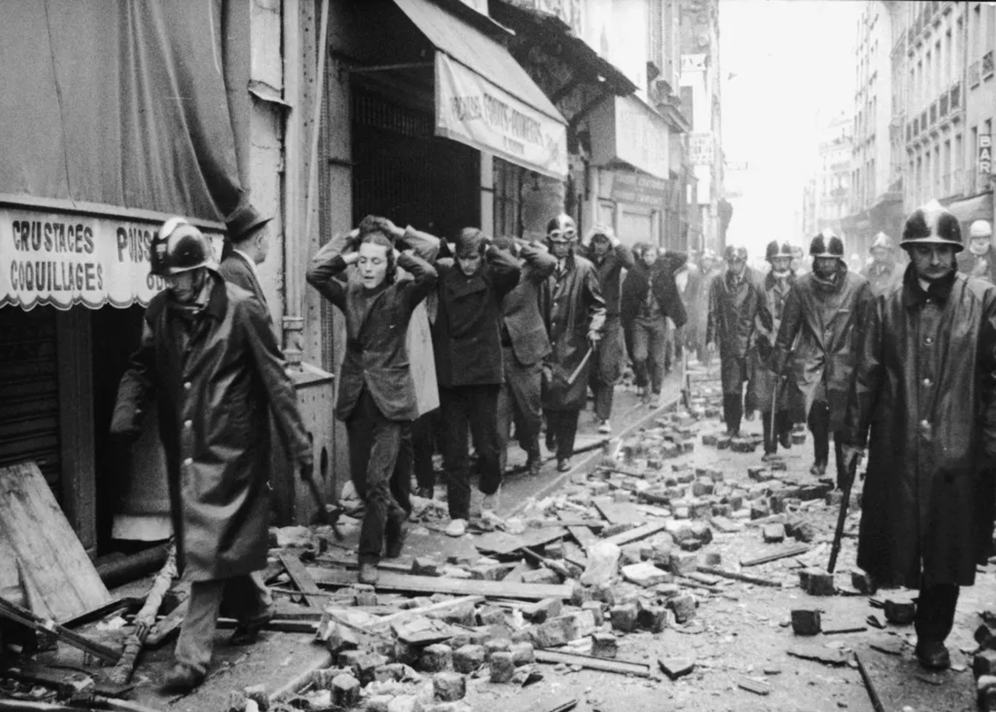
Fig. 8) Students in the Latin Quarter of Paris being led to a police station on May 11, 1968. Hundreds of students were arrested or hospitalized during protests that night. Image Credit: Associated Press; Image Source: https://www.nytimes.com/2018/05/05/world/europe/france-may-1968-revolution.html
Endnotes
At its farthest point, the crew in the Orion spacecraft was 252,756 miles away from Earth. https://www.nasa.gov/news-release/nasas-artemis-ii-crew-eclipses-record-for-farthest-human-spaceflight/
Browne, Malachy and John Ismay. “U.S. Tomahawk Hit Naval Base Beside Iranian School, Video Shows.” New York Times. March 8, 2026. https://www.nytimes.com/2026/03/08/world/middleeast/iran-minab-school-strike.html
Referred to by Iran as “Operation True Promise.”
Airwars Staff. “Record Pace of Strikes in Iran Bombing Campaign: Analysis.” Airwars. March 6, 2026 https://airwars.org/record-pace-of-strikes-in-iran-bombing-campaign-analysis/
Ibid.
Blake, Aaron. “How the Iran War’s Unpopularity Compares to Iraq, Afghanistan, and Vietnam.” CNN, July 20, 2020. https://www.cnn.com/2026/07/20/politics/iran-war-unpopularity-iraq-vietnam
Kelsey, Robin. “Reverse Shot: Earthrise and Blue Marble in the American Imagination.” Scales of the Earth: New Geographies 4. Edited by El Hadi Jazairy, Cambridge: Harvard University Press, pp. 10-16.
Cosgrove, Denis. Apollo’s Eye: A Cartographic Genealogy of the Earth in the Western Imagination. Baltimore: The Johns Hopkins University Press, 2001: 279.
Brumfiel, Geoff. “Google Pauses AI Satellite Images, After Fears of Deepfakes in the Sky.” NPR. July 31, 2026 https://www.npr.org/2026/07/31/nx-s1-5914652/google-adds-ai-to-satellite-images-raising-fears-of-deepfakes-in-the-sky
Yaden et al. “The Overview Effect: Awe and Self-Transcendent Experience in Spaceflight,” Psychology of Consciousness: Theory, Research, and Practice, 2016, Vol. 3, No. 1, 1-11: 1.
“The Event that Saved 1968.” PBS https://www.pbs.org/wgbh/americanexperience/features/moon-event-saved-1968/
Rouffin, Gaspard. “US Satellite Imagery Restrictions Leave Journalists in the Dark on Iran and Gaza.” Middle East Eye. August 28, 2026 https://www.middleeasteye.net/news/us-satellite-imagery-restrictions-leave-journalists-dark-iran-and-gaza
Ibid.
Ibid.
An amendment to the US Land Remote Sensing Policy Act in 1992, which at the time set a 0.5m resolution for publicly available US satellite imagery, dictated a reduced resolution of 2.5 m for Israel and the Palestinian territories it occupies. Please see “At the Threshold of Detectability” in Weizman, Eyal. Forensic Architecture: Violence at the Threshold of Detectability. Brooklyn: Zone Books, 2017, 13-33.
Tracy Valcourt is a Social Sciences and Humanities Research Council Postdoctoral Fellow at York University. Her research investigates how AI-generated imagery is contributing to a digital fog of war and the subsequent challenges it presents to visual investigators. She has taught in the Department of Art History at Concordia University and in the School of Social Sciences, Arts, and Humanities at Al Akhawayn University in Ifrane, Morocco. In addition to scholarly publications, she writes on art, architecture, and technology for magazines such as Border Crossings, Esse, and Heliotrope.