
Military Slopaganda and The Colonial Logics of AI Race

BY VINCENT E.
In a 10-second video, a man in a military uniform hugs his friends, plays with a dog and then walks up a stairway, leading to a light in the sky, as his friends wave him goodbye. In the background a rock song with the lyrics: “You are still alive/forever in my heart // You are still alive, but fate decided otherwise”. The song belongs to Russian singer, songwriter and producer Maxim Fadeev, who actively supports the Russian full-scale invasion in Ukraine and has held the position of “trusted person of Vladimir Putin” since 2018 (Oblast 2018). The notion of “trusted person of a presidential candidate” according to Russian Federal Law “On the Elections of the President of the Russian Federation”, means someone who would advocate for the presidential candidate’s election and support his campaign. However in the context of the authoritarian Russian state, when the election procedure is purely symbolic, the position of the “trusted (Federal Law 2003) person of Vladimir Putin” signifies complete support of the current political and social status quo.
After 2022, Fadeev’s song became an unofficial hymn to the Russian soldiers in Ukraine, mourning their dead comrades.The video is one of dozens of AI-generated obituaries of Russian soldiers killed in Ukraine while participating in the colonial war. In every image, a Russian soldier is portrayed as Angelica - ascending to the sky with a ladder, having wings, or standing in front of the gates of heaven, hugging his relatives.
These videos exemplify the way AI blurs the boundary between soldier and civilian and introduces the notion of military slopaganda (Klinzewic et.al 2025) as one of the methods of cybernetic warfare, producing the subject of the Russian soldier and, in doing so, creating the figure of his enemy – an evil Ukrainian soldier, who killed the seemingly innocent Russian men. These images are weapons, and exist in the context of the larger-scale ways Russian state officials describe their participation in the “AI race”. AI accelerates existing colonial dynamics to “conjure”(Della Ratta 2025) colonial futures.
Where are the obituaries?
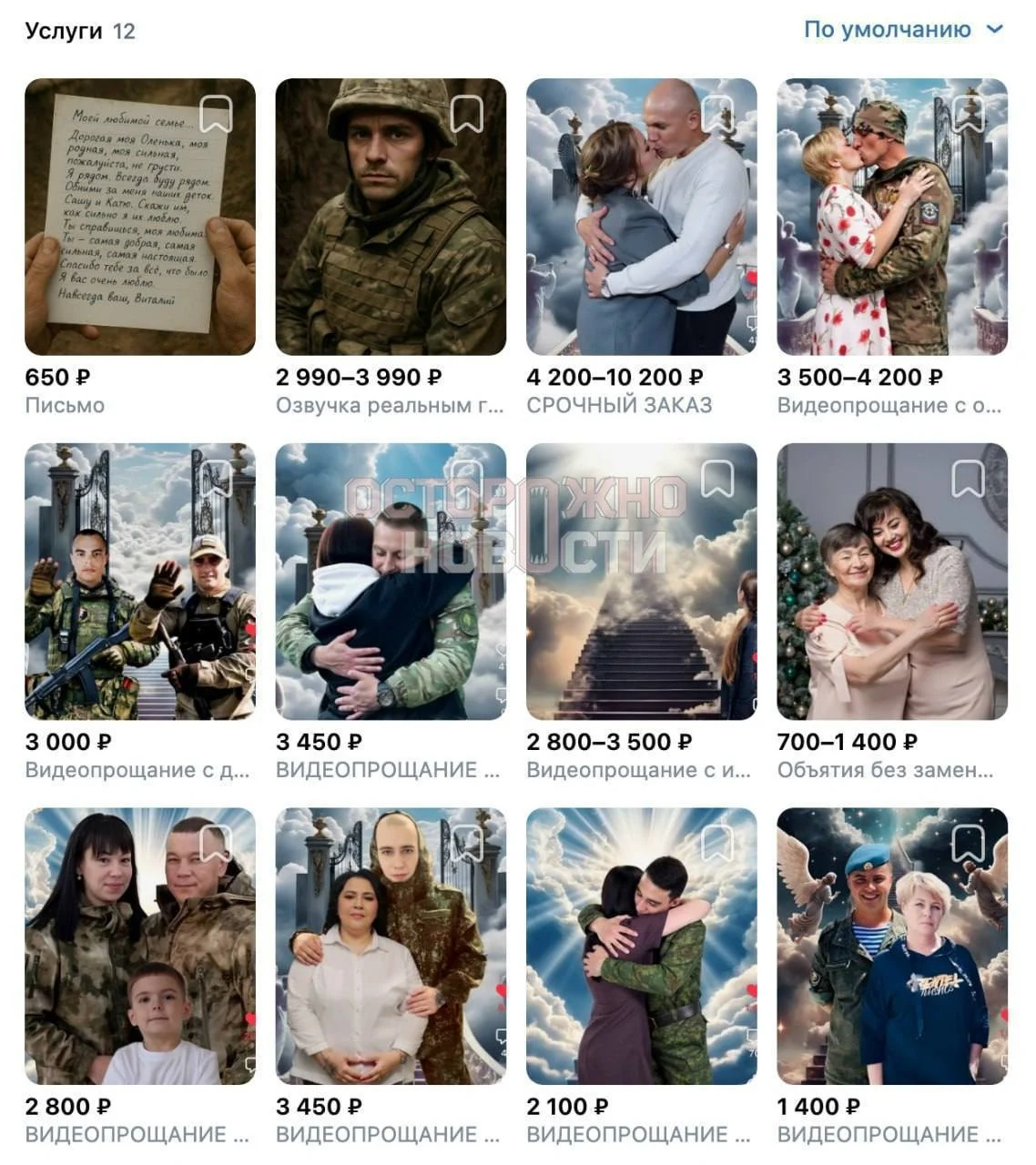
These images originate on a VKontakte page called “Video farewell Official”. The top of the page lists services that range from a letter written by the dead person in his own handwriting and addressed to his family, to a farewell, “made with the real voice” (Vkontakte 2026) of the dead person. Vkontakte was originally developed by Russian entrepreneur Pavel Durov. (Only Social 2024) It is now a part of the mail.ru group, owned by Vladimir Kiriyenko, a Russian businessman and the son of the First Deputy Chief of Staff of the Presidential Administration of Russia, Sergei Kiriyenko (Open Sanctions). Before that, the site was owned by another Russian oligarch, Alisher Usmanov, co-owner of Russian mobile phone operator MegaFon (Dyer-Witheford & Matviyenko 2019), and now former co-owner of the Mail.ru group, one of the largest Russian-speaking internet companies. He acquired the company after Durov was forced to sell it and flee the country, after refusing to provide data on Ukrainians protesting against the Russian occupation of Donbas and Crimea in 2014 (Only Social 2024). During the same period, VKontakte was used to disseminate Russian propaganda, undermining the Maidan revolution and supporting the Russian occupation of Donbas and Crimea (Dyer-Witherford & Matviyenko 2019). As Svitlana Matviyenko and Nick Dyer-Witherford explain, the use of social media for propaganda as well as the attempts to acquire information about the protests from social media platforms exemplifies the “weaponisation of data” in contemporary cyberwarfare. Thus the platform which facilitates the creation of the soldiers’ obituaries is deeply embedded in Russian propaganda networks.
The services the administrators of “Video Farewell Official” provide do not attempt to create post-death bots, which have been the primary focus of conversations about AI and death (see for example - Banks 2024); they do not promise interaction. At the same time, once the images are posted on a VKontakte page with an obituary, they accumulate comments affirming the loss under the videos commemorating dead soldiers. These comment sections are full of users referring to the soldiers as “heroes” and affirming the relatives’ feelings of loss and grief. The soldiers’ obituaries emphasise a combination of “fulfilment of duty”, “courage”, as well as celebrating the soldiers’ roles as “father” to their families. Journalist Alesya Sokolova identified similar narrativas in her analyses of AI generated images and narratives spread across non-political groups in Vkontakte. As Sokolova shows, since the start of the full-scale invasion of Ukraine, Vkontakte groups for older women are filled with stories about “heroic Russian men” who died in the war” with some external enemy whose existence does not require additional explanation, « protecting the interests of the country.” (Sokolova 2024) These narratives are what Michał Klincewicz, Mark Alfano and Amir Ebrahimi Fard call slopaganda.
Slopaganda refers to: “unwanted AI-generated content that is spread in order to manipulate beliefs to achieve political ends.” (Klincewicz et al 2025) Similar to the AI generated narratives Sokolova identified, most comments in the Video Farewell Vkontakte group as well as on the obituaries themselves refer to the dead soldiers as “martyrs” and “heroes". In a way, the dead soldiers do not even need to be real; their online images just need to perform martyrdom.
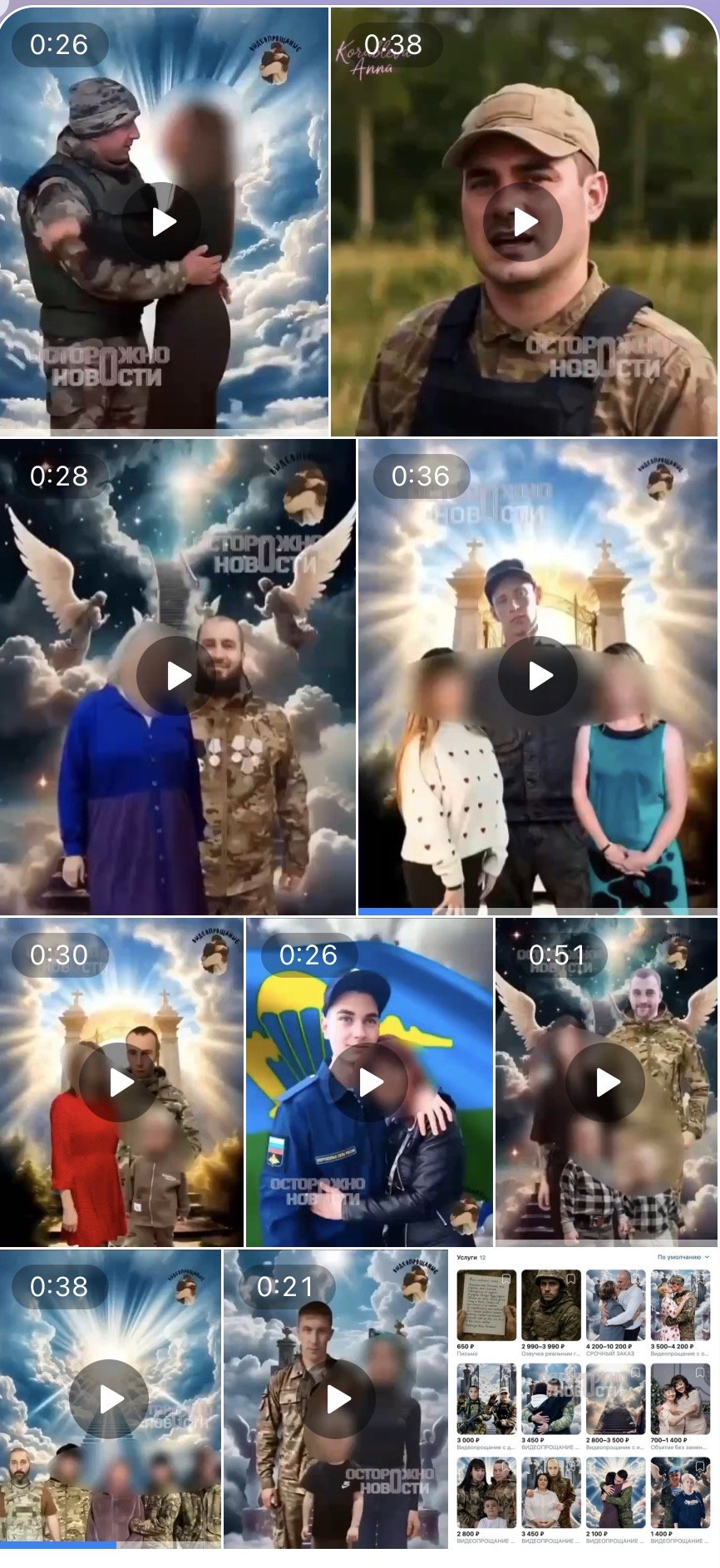
From the VKontakte page, these videos moved to the Telegram channel “Ostorojno Novosti” (Be careful! News!) – a more than 1.5 million subscriber news channel owned by Ksenia Sobchak, a Russian socialite who is also an alleged goddaughter of Vladimir Putin. Telegram is also platform, indicative of the methods of Russian propaganda. While it presents itself as a “freedom messenger”, Telegram’s infrastructure is tied to the Russian Federal Security Service (FSB). As investigative journalists Roman Anin and Nikita Kondratiev from Insider media recently discovered, Telegram’s server infrastructure is maintained by the same company which maintains FSB’s surveillance complex (Anin & Kondratiev 2025). According to Anin and Kondratiev’s investigation, the Russian-based company Electrontelecom, which has access to telegram users’ IP addresses and maintains its server infrastructure also provides server infrastructure that allows the Russian Federal Security service to conduct surveillance on Russia’s citizens.
Telegram’s infrastructural implication in the Russian surveillance system, as well as the ownership of the Telegram news channel, suggests how soldier obituaries travel across Russian propaganda channels.
In the process of moving from a Vkontakte page to the 1.5 million subscriber Telegram channel, the videos solidified their status as slopaganda. As Michał Klincewicz, Mark Alfano and Amir Ebrahimi Fard explain, slopaganda is designed to influence its viewers’ political opinions, but at an accelerated scale, scope, and speed. AI software’s accessibility makes image production easier, allowing it to be tailored to different groups and to be distributed much more quickly and through more channels.(Klincewicz et.al 2025)
Although originally the term was developed to specifically apply to disinformation, it is also relevant to the videos I am looking at. First, to follow Sokolova’s investigative conclusions, the “dead heroes” slopaganda is directed at older women. However, the group’s content makes the targeting even narrower. While the group was first created for as part of the mourning practice for those who have lost relatives and loved ones, the dead soldiers' obituaries changed the group’s function – these videos use empathy for someone’s loss for propaganda purposes.
Secondly, the speed with which the videos are made allows them to be distributed widely, reaching far beyond their intended audience, appearing not only on a Vkontakte page, but spreading much further through Telegram reposts. But what happens next? To understand that we must discuss the “military” in “military slopaganda”. These images are not made to convince the soldiers that they’ll go to heaven after being killed on the battlefield. They serve a specific function within the Russian colonial war.
Operations of Military Slopaganda
These images should be understood in the context of reporting and commemorating previous Russian colonial wars. The obituaries reproduce decontextualised narratives of “duty” and “heroism”, similar to those of the second Chechen war. In the words of media historian Natalia Danilova, during the second Russian invasion of Chechnya, the obituaries of Russian soldiers linked “professionalism with patriotic values”. As she explained, “[t]his construction introduces the idea of ‘patriotic professionalism’, which legitimates the death of soldiers by their dedication to military duty and loyalty to the country.” (Danilova 2015, 130) Reproducing the narratives of the previous colonial war, the dead soldiers’ obituaries are “operational”. Harun Farocki defines operational images in relation to their use in colonial warfare as images that “do not represent an object, but rather a part of an operation”.(Faroki 2004, 18). In that context, the “operation” is the one that takes place on the battlefield. For him, operational images are “technical” in the sense that they are used to aim weapons in the American invasions of Iraq and Afghanistan. Expanding on this, Jussi Parikka emphasizes the “primacy of action” of the operational images (Parikka 2023, 19). However as he shows, operational images are used in “operations other than war”, which means they are used on and beyond the battlefield as part of a “broader infrastructure of skills, labor, techniques, and technologies, and how institutions assemble images for their particular needs and uses” (Parikka 2023, 20). As an example of the operational images on and beyond the battlefield, Anna Engelhardt expands upon both Harun Faroki and Jussi Parikka’s definition to discuss simulated images of military operations, used both on the battlefield (for an army pilot) and beyond it (widely circulating simulated images of military operations). As she shows, in both cases these simulations serve a specific function – they “produce an information environment that can be operationalised in different ways” (Engelhardt 2024, 156). Like the images Anna Engelhardt analysed, the soldiers’ obituaries are operational insofar as they produce an environment. In the process of being circulated across different platforms, they create the subject of a Russian soldier as well as normalising the colonial invasion for the domestic audience by framing participation in colonial warfare as a “duty”.
In producing the figure of the Russian soldier – an angel going to heaven, who loves his family and serves his country, these images simultaneously cement the production of the colonial other. Because someone must have killed that apparently wonderful human, who was so kind and noble. These images are an extension of “slopaganda” as their function is not to convince; they participate in producing the reality of contemporary Russian colonial warfare by making it legible for the audience inside the country, creating a Ukrainian subject as “evil”, someone capable of murdering “angelic” Russian soldiers.
These images become part of what Dyer-Witherford and Matviyenko termed “cyberwar”. In the context of Web 2.0, cyberwar is the weaponisation of communication. As they put it, cyberwar “operates through apparatuses of subjectification that work across platforms and are aimed at the populations of these platforms (populations that can be conceived of as combined human–device assemblages) both at home and abroad” (2019, 93). The apparatuses of subjectification can be understood as the way one gets “recruited” to act in the interest of one or another state, while also existing within the networks of global capital.
Military slopaganda recruits those it targets in this case to act in the interests of the Russian state — its pace, accelerated by AI, is crucial to this function. The AI videos’ creator(s), the dead soldiers’ families and the journalists distributing the videos become subjects of cybernetic warfare. They contribute to the operation of Russian colonial warfare on and beyond the battlefield, along with the commenters, who may or may not be human. The platforms these videos get distributed through co-create military slopaganda on an infrastructural level, allowing for bot swarms and user surveillance.
Operating both on and beyond the battlefield, military slopaganda disrupts clear distinctions between military and civilian. While this situation is not unique to the conditions of cyberwarfare, the speed of operation afforded by the use of AI accelerates existing patterns of cyberwar to a previously unimaginable speed.
Accelerated Machines of Genocide
It is not possible to trace which specific software was used to create the images or the location of the servers that enabled their creation. However, the blurred to the point of inexistence boundary between the “civilian” and “military” uses of AI is part of a larger trend described as the “AI race”. In a matter of days both Putin and Trump claimed participation in a Cold War-like technological race. On November 19, Putin spoke about the necessity of developing local AI technologies in order to achieve “state, technological and ideological sovereignty” (Support Magazine 2025), which for him included developing what he earlier referred to as “advanced AI”, by which he means so-called Artificial General Intelligence (AGI). In less than a week, on November 24, Donald Trump announced a “Genesis Mission”, “to prioritize America’s global dominance in AI to usher in a new golden age of human flourishing, economic competitiveness, and national security” (The White House 2025). Like its Russian counterpart, “the Trump Administration is planning to rely on existing data centers as well as to build more to 'win and stay ahead in the AI race”. Like Putin, Trump is concerned with the development of AGI and is currently investing in constructing of large-scale data centres to support it.
Paying attention to data center infrastructures provides a counterpoint to the Cold War-era-esque narratives, revealing the way AI infrastructures harm entire lifeworlds and communities. Uruguayan researcher Daniel Pena notes that the large scale infrastructures currently required to maintain generative AI’s operation and to sustain the constant promises of accelerating and archiving AGI, “are extractivist projects that come to the Global South to use cheap water, tax-free land, and very poorly paid jobs”. As he elaborates: “[a]nd then they don’t contribute to our country; they don’t improve our internet access”. The constantly increasing scale of expansion of data centre infrastructures (Hao 2025, 284) for Silicon Valley-based companies in countries like Chile and Uruguay, coupled with the lack of accountability to the local population, reproduces and accelerates previous patterns of colonialism. As Schutze puts it: “[a]lgorithmic colonialism moves along and intensifies the same lines as the climate crisis does. Commonly, those who suffer the most from climate effects are also the ones exploited and expropriated by the AI industry” (Schütze 2024, 23). The violence of the technological determinism embedded in the idea of developing AGI moves along the lines of imperial plunder and resource extraction embedded in colonial modernity’s formation.
The reproduction and acceleration of colonial dynamics provides a counterpoint to the language of “AI race”, revealing the violence required for its maintenance. Started in the 1950s, by “four white men” (Timnit & Torres 2024, 12), the contemporary field of AI research frames the race to AGI as existential to “avoid accountability for the harm it causes” (Timnit & Torres 2024, 12). The reproduction of Cold War rhetoric, as well as AI’s historical roots in the Cold War, allow us to see previous research on the coloniality of Cold War narratives as a blueprint for analysing the so-called AI race.
For example, existing analyses of the “nuclear weapons race” have repeatedly pointed out that the narratives of competition between empires conceal the acceleration of colonial violence in the name of progress and the sovereignty of the settler states. For example, Maurer, Anaïs, and Rebecca H. Hogue propose the notion of “nuclear imperialisms” to define “overlapping modes of nuclear oppression that involve multiple empires, technologies, and ideological framings that exist and extend beyond geographic, temporal, and national boundaries and borders” (Maurer & Hogue 2020). Their logic allows us to see beyond the colonial violence of one empire, instead tracing how both competition and collaboration between empires, as well as maintening “sovereignty” against adversaries, become justifications for accelerated colonialism.

The American use of military slopaganda is exemplified by a recent picture of Trump and Netanyahu enjoying a cocktail and images of a Golden Gaza Tower, distributed amidst the ongoing US-funded genocide in Gaza. Like the military slopaganda videos, this image circulated across platforms, normalising colonial violence to both international and domestic audiences. This image exemplifies the way competition between empires works to normalise colonial violence, much like warfare technologies of the past. The predictions of “progress” and “flourishing” this image conjures are only possible with the complete annihilation of Gaza. Like the obituaries of the soldiers, this image’s role is not just to represent, it is to act. In the words of Donatella Dela Ratta, the AI-generated images of the “future of Gaza” filled with US-built skyscrapers, “conjure a future” of colonial violence, which “did not happen yet, but one that artificial intelligence” is already making feel inevitable. (Dell Ratta 2025)
I cannot trace the locations of Russia’s data centres from where I sit at my desk. However, the violence of AI prediction, formulated by Donatella Dela Ratta, provides a framework for dissecting the Russian state’s discourse around AI. While Putin claims that Russia is participating in the AI-race due to sanctions, neither state-funded research centres nor Russian companies have access to the hardware required for the accelerated development of new LLMs or other seemingly “civilian” technologies (T-invariant 2025). However, according to Vladimir Putin’s alleged daughter and head of the Russian “National Institute of AI”, Katerina Tikhonova, the key priorities of the Russian development of AI are “much more pragmatic”. They are “conditioned by the challenges that Russia is currently facing, namely the usage of AI in Unmanned Aerial Vehicles and oil extraction” (T-invariant 2025). Each of these uses requires further investigation, which is beyond the scope of this piece. However, by briefly addressing these examples, I can show how the current and predicted use of AI accelerates existing colonial dynamics.
Tikhonova’s comments show that AI is used primarily to support Russia’s interconnected colonial enterprises. Drone warfare is currently widely used in Russia's full-scale invasion of Ukraine. For the Russian army, the use of AI in drones is a method of “reshaping”, making the murder and destruction of civilian infrastructure more “effective” (Thakur 2025). The (primarily illegal) (Parker 2025) sales of oil extracted from Indigenous lands make it possible for the Russian colonial war to continue. The money from oil sales facilitates the purchase and development of weapons. AI accelerates resource extraction, creating the possibility of faster profits. For example, in the words of the director of geoprocessing of Russian oil company Gazpromneft Yuriy Masalkin, “thanks to the usage of AI the company accelerated the interpretation of seismic survey results by 10 to 30 percent, which allowed it to advance the start of field development by approximately a year” (AI,TASS 2025). The accelerated resource extraction from Indigenous lands contributes to the accelerated development of weapons for colonial warfare. The acceleration of the machines of genocide and plunder, similar to the AI-generated images of Gaza, “conjures” a seemingly inescapable colonial future.
Hope? Idk. Maybe? Definitely not in AI
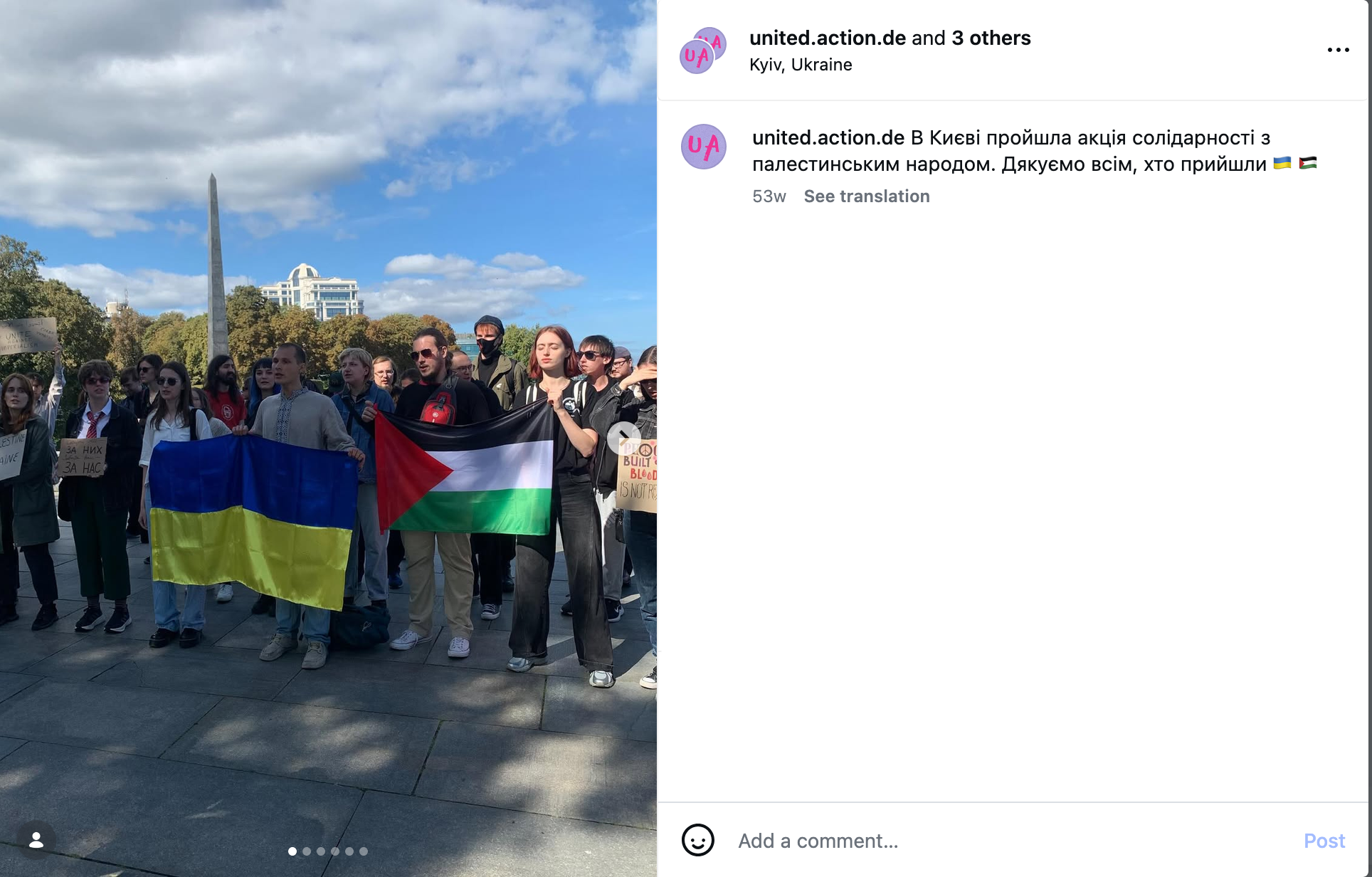
AI’s acceleration of colonial dynamics does not leave room for much hope. The main source of what hope remains for me is translocal1 solidarity, transcending the divisions created by the settler states. One sources of such hope was a demonstration in solidarity with Palestine, which took place in Kyiv on September 20, 2025. One of the posters read, “Long Live Palestine. Glory to Ukraine” (Instagram Post September 20, 2025); others spoke about the shared patterns of genocide and starvation experienced by the Ukrainian and Palestinian people; another said “From Ukraine to Palestine, Occupation is a Crime.” Participants at the demonstration resisted both the US-funded genocide and the Russian full-scale invasion. One gathering in Kyiv cannot dismantle the accelerating creation of colonial futures, yet through their bravery and care for others, its participants conjured a decolonial future, one finally free from settler states.
Endnotes
1. I use the notion of "translocal" to highlight the connection between specific localities situated in their political struggles, rather than between entire nations (as in transnational). I borrow the notion of translocal from Macarena Gómez-Barris who writes: 'Translocalities' is defined by a hemispheric politics based on feminist knowledge production that emerges in spaces of Black and Brown solidarity and in the transits of the South, North, and Caribbean middle spaces of the Américas, or the crosscurrent flows of political activity. The concept of translocalities comes directly from dissident spaces of solidarity, where social interaction and embodied knowledge transfers are immensely valued." In Gómez-Barris, Macarena. Beyond the Pink Tide: Art and Political Undercurrents in the Americas. University of California Press, 2018. I also borrow the notion of “translocal” from my colleagues: the organizers of the online/offline platform “Feminist Translocalities” https://feminisms.co/en and the collective of Typography Worldwide and their project “Translocal Dialogues On Home, Migration and Solidarity” https://typography-worldwide.org/en/
Bibliography
Federal Law dated 10.01.2003 N 19-ФЗ (edition 08.08. 2025) "On the Presidential Elections” Accessed January, 17, 2026 (In Russian) "https://www.consultant.ru/document/cons_doc_LAW_40445/e19d6d8db4f8da37f5a6814a77883caf0095a292/
Producer Maxim Fadeev Became A Trusted Person of Vladimir Putin” (In Russian). Oblast January, 23. 2018 https://oblast45.ru/publication/19675
Klincewicz et al 2025. “Slopaganda: The interaction between propaganda and generative AI” https://arxiv.org/abs/2503.01560
Donatella Della Ratta. 2025. Ask Me for Those Unborn Promises That May Seem Unlikely to Happen in the Natural. https://networkcultures.org/void/2025/04/10/ask-me-for-those-unborn-promises-that-may-seem-unlikely-to-happen-in-the-natural-live-video-essay/
Videoproshanie Official.(Vidoefarewell Official) (In Russian) Vkontakte. Accessed January, 17, 2026 https://vk.com/club230394825?from=search
What Is VKontakte? 7 Things You Should Know About the Russia’s Facebook. Only Social, November, 13. 2024 https://onlysocial.io/7-things-to-know-about-the-russias-facebook/
Vladimir Kiriyenko. Open Sanctions https://www.opensanctions.org/entities/Q5680808/
Dyer-Witheford, Nick, and Svitlana Matviyenko. 2019. Cyberwar and Revolution : Digital Subterfuge in Global Capitalism. Minneapolis: University of Minnesota Press.
What Is VKontakte? 7 Things You Should Know About the Russia’s Facebook. Only Social, November, 13. 2024 https://onlysocial.io/7-things-to-know-about-the-russias-facebook/
Dyer-Witheford, Nick, and Svitlana Matviyenko. 2019. Cyberwar and Revolution : Digital Subterfuge in Global Capitalism. Minneapolis: University of Minnesota Press. 80
Banks, J. 2024. Deletion, departure, death: Experiences of AI companion loss. Journal of Social and Personal Relationships, 41(12), 3547-3572. https://doi.org/10.1177/02654075241269688 (Original work published 2024)
Alesya Sokolova. Tailored propaganda: how Russia manipulates public opinion in VK. Cedar. July, 2024 https://cedarus.io/research/tailored-propaganda#heading-0
Roman Anin, Nikita Kondratiev. Telegram, the FSB, and the Man in the Middle. Istories. June, 10, 2025 https://storage.googleapis.com/istories/en/stories/2025/06/10/telegram-fsb/index.html
Danilova, Natalii︠a︡. 2015. The Politics of War Commemoration in the UK and Russia. Houndmills, Basingstoke, Hampshire: Palgrave Macmillan. 1https://doi.org/10.1057/9781137395719. 130
Farocki, Harun.2004. Phantom Images. Public, (29). Retrieved from https://public.journals.yorku.ca/index.php/public/article/view/30354 18
Parikka, Jussi. 2023. Operational Images : From the Visual to the Invisual. Minneapolis, MN: University of Minnesota Press. 19
Engelhardt Anna. Fear of the Synthetic Image in Militant Media. 2024 Edited by Riccardo Badano, Tomas Percival, and Susan Schuppli. Leipzig, [London]: Spector Books ; CRA Press. 156
Vladimir Pitin Inisiiroval Sozdanie.. (In Russian). Support Magazine, November, 21. 2025 https://support-magazine.ru/novosti/vladimir-putin-initsiiroval-sozdanie-federalnoj-programmy-razvitiya-data-tsentrov-dlya-iskusstvennogo-intellekta/
Launching the Genesis Mission, The White House, November, 24. 2025 https://www.whitehouse.gov/presidential-actions/2025/11/launching-the-genesis-mission/
Hao, Karen. Empire of AI: Dreams and Nightmares in Sam Altman’s OpenAI. Penguin Press, 2025. 284
Schütze, Paul. 2024 “The Impacts of AI Futurism: An Unfiltered Look at AI’s True Effects on the Climate Crisis.” Ethics and Information Technology 26, no. 2: 23. https://doi.org/10.1007/s10676-024-09758-6.
Gebru, Timnit, and Émile P. Torres. 2024. “The TESCREAL Bundle: Eugenics and the Promise of Utopia through Artificial General Intelligence”. First Monday 29 (4). https://doi.org/10.5210/fm.v29i4.13636.
Maurer, Anaïs, and Rebecca H. Hogue. “Introduction: Transnational Nuclear Imperialisms.” Journal of Transnational American Studies 11, no. 2 (2020). https://doi.org/10.5070/T8112050495.
“Sovereign” Means Military: How Russia Militarized AI, Drone, and Cryptography Industries. T-invariant. March, 20, 2025 https://t-invariant.org/2025/03/sovereign-means-military-how-russia-militarized-ai-drone-and-cryptography-industries/
Vijainder K Thakur. New Russian Drones “Reshape” Ukraine War; AI-Powered Autonomy Outmaneuvers Kiev’s Defenses, Eurasiatimes, October, 9, 2025 https://www.eurasiantimes.com/new-russian-drones-reshape-ukraine-war/
Parker Jessica On the front line of Europe's standoff with Russia's sanction-busting shadow fleet. BBC. November, 18. 2025 https://www.bbc.com/news/articles/cz91dk0l50no
Gazprom Neft has advanced the start of oil field development by about a year using AI.TASS. Decenber, 12. 2025. https://tass.ru/ekonomika/25912737
“Kyiv hosted an action of solidarity with the Palestinian people. Thank you to everyone who came” Instagram post by United Action.UA. September, 20. 2025 https://www.instagram.com/p/DO05Ul5DFTm/?img_index=1
Vincent E. writes, curates, teaches, moderates, organizes, dreams, and plots. They live as an uninvited settler in Katarokwi (Kingston), on land stolen from the Anishinaabek, Haudenosaunee, and Huron-Wendat peoples. In their doctoral research at the Department of Film and Media at Queen’s University they examine the Cold War-era nuclear optimism from a decolonial perspective, focusing on the ways how Soviet nuclear colonialism was normalized through the forms of international communication.