
I love meat, I despise meat: A relational understanding of ambivalent feelings
BY AMALIE SCHEEL
In this essay, I will be thinking and, quite literally, feeling my way through (Highmore, 2017) the concept of relationality in and between feelings. I situate this process in my ethnographic work on feelings towards meat-eating in Denmark, a country that identifies equally with its passion for and export of bacon as well as its ambitions to reduce CO2 emissions, making meat a contested topic in this cultural context. While I write this alone, I include other people's voices, with interludes from a theorist, a research participant, and a seemingly unrelated by startling insightful football fan. I draw on these voices not only as references, but also as agents in the piece that sometimes support and sometimes intervene in my argumentation (see more on critical citation practices in Diatta (2023)). The piece ends with a visualization of the argument which is less an attempt to neatly wrap up the conclusion than an object to think with and adjust, and for the reader to tinker with as it adapts and takes shape in new contexts.
A relational approach
In my study of Danes’ experiences of and struggles with meat I have often resorted to human-food theorizations that treat embodiment (Carolan, 2016) and viscerality (Probyn, 2003) as key concepts through which to understand the world and the relations between the bodies that we inhabit and the bodies that we eat. I have come to focus particularly on how felt sensations – points of contact between bodies and environments – form ideas and politics at the same time that ideas and politics fundamentally shape bodies’ contact with the world (Ahmed, 2014). This line of thinking made me wonder how felt intensities constitute our relations in the world.
Interlude 1: “You see, there is no singular consciousness; no one way to reach out and know the world sensually. Our knowledge of the world, rather, is constituted through our relationalities. And as those relationalities change so too change understandings of what is and what ought to be.” (Carolan, 2016)
Being in the world is always and inevitably a process of being in relation to others - to other people, to foods, to animals and environments and objects in the broadest possible sense of the word. These relations between individuals and their surroundings, the ties that connect bodies to food, memories, and social norms generate attachments and resistances, likes and dislikes. They create my favorite childhood food, spit-roasted pig, and the horror of looking the poor pig directly in the holes where its eyes once were. Moreover, these relations are socially and culturally constituted, creating ripples of experience between individuals and society, between discourse and felt experiences. In a time when we question eating habits for many good reasons, the relations between humans and meat are also inevitably changed, complicating our feelings and ideas about a food already complicated by the fact that it is (or was) also a living being (see, e.g., Fiddes (2004)).
Interlude 2: “The first thing I thought of was the smell of food, and it's Christmas Eve and roast duck. And later... The smell of blood, and then I also get a bit nauseous.” (quote from a research participant describing their associations with meat).
In my research context, these relations are extremely ambivalent. When I interview research participants, they continuously express their love for meat, their nostalgic memories of it, and how good the taste makes them feel. In the same breath they express the guilt they feel when consuming it, how it makes them sad to think about the animals that have been heartlessly tortured and killed and the effects the steak on their plate has on the environment. In many instances, these feelings co-exist in the same instant, when you bite down and start to chew.
Interlude 3: “We are only fans of our football club by virtue of other football clubs’ fans and vice versa. We, as a small club, thrive in the shadow of the city’s big club, and they thrive by having us to be bigger than. We make louder noises in the stadium because we have other noises to drown out. In that way all fan groups are always in relation to one another” (quote from a dedicated fan of the small Danish football club, Aarhus Fremad, at a public event about sport fan culture which I attended)
But instead of just co-existing, these feelings might be relational in themselves. What if our deep nostalgic relation to barbecued steak is illuminated through our ethical concerns with eating other living beings? Might it be that the one feeling happens not because of, not as an effect, but in tandem with the other feeling, like when rival football fans raise their roar to drown each other out. In their influential book Cruel Optimism (2013), Berlant writes about the seemingly paradoxical, or at the very least mindboggling, idea of desiring something that will inevitably stand in the way of your flourishing. Extending this point about the relations between simultaneously dis- and conjoining feelings, I wonder if these chafing and rubbing feeling-relations are not just an outcome but actively shape and maybe even accentuate each other.
One version of this could be what is popularly called ‘guilty pleasures’, cultural objects (like television shows, music, or food items) that we enjoy while knowing, or at least believing, that we should not, either because they are deemed socially unacceptable or because our values are not fully aligned with what we perceive as the values of the object. In these cases, it is hard - and possibly beyond the point of social research - to fully determine how much the pleasure is a result and/or independent of the guilt. Nonetheless, it prompts questions about the complicated configurations of feelings if we see them as in an armlock with each other.
While my thinking on this issue grew out of a preoccupation with human-food relations, it is not necessarily particular to this context. Perhaps this framing could help us to understand affective relations between people and all the other objects we hold ambivalent, often shameful, feelings towards. From a smartphone with its hilarious and comforting dog memes inseparable from its soul-crushing doomscroll to the rising temperatures that for the people living in temperate climate zones allow an extra month of outdoor serving at cafés while the mild breeze whispers (or screams) “the end is near”.
What would it imply if we understand these contradictory feelings as tightly knit and reliant on each other? That my Sunday morning ritual of bacon breakfast burritos also shapes, reinforces, or alters my reluctance to reach for the bacon in the supermarket on Saturday evening. What could understanding feelings towards politicized objects like this do for the ways we understand all our knotty – and naughty – feelings in a time when we want to change for all the right reasons, but fail to act for all the wrong feelings.
A model to think and ask with
I end this essay with a model of how I – tentatively – visualize this idea. The model is rough and malleable, hastily drawn in a moment of inspiration, emphasizing its preliminary nature. It is at the same time simple and strangely abstract. I end with this model, following Heliotrope’s suggestion for authors not to conclude but instead to invite readers to think with me on how we could extend, adapt, and tinker with this conceptualization, particularly as it meets other empirical contexts, other bodies, other environments. To me, this visualization illustrates the qualities and effects of thinking relationally; how contrasting feelings simultaneously illuminate, expand, and entangle each other. In the visualization, the one feeling (green bobble) has a directionality towards another feeling (blue bobble) by virtue of their difference, and this directionality (green curved lines) entangles with the directionality of the other feeling (blue curved lines) thus impacting the other feeling. At the same time, the visualization prompts further questions, like, what happens in the places where two lines (two directionalities) meet? And what would happen if the two feelings overlapped? In what contexts would that be the case? This is not an end-all and be-all model or theory, but hopefully it does some of what good theory does: resonates in and with the world, leading to informed questions as much as to possible answers.
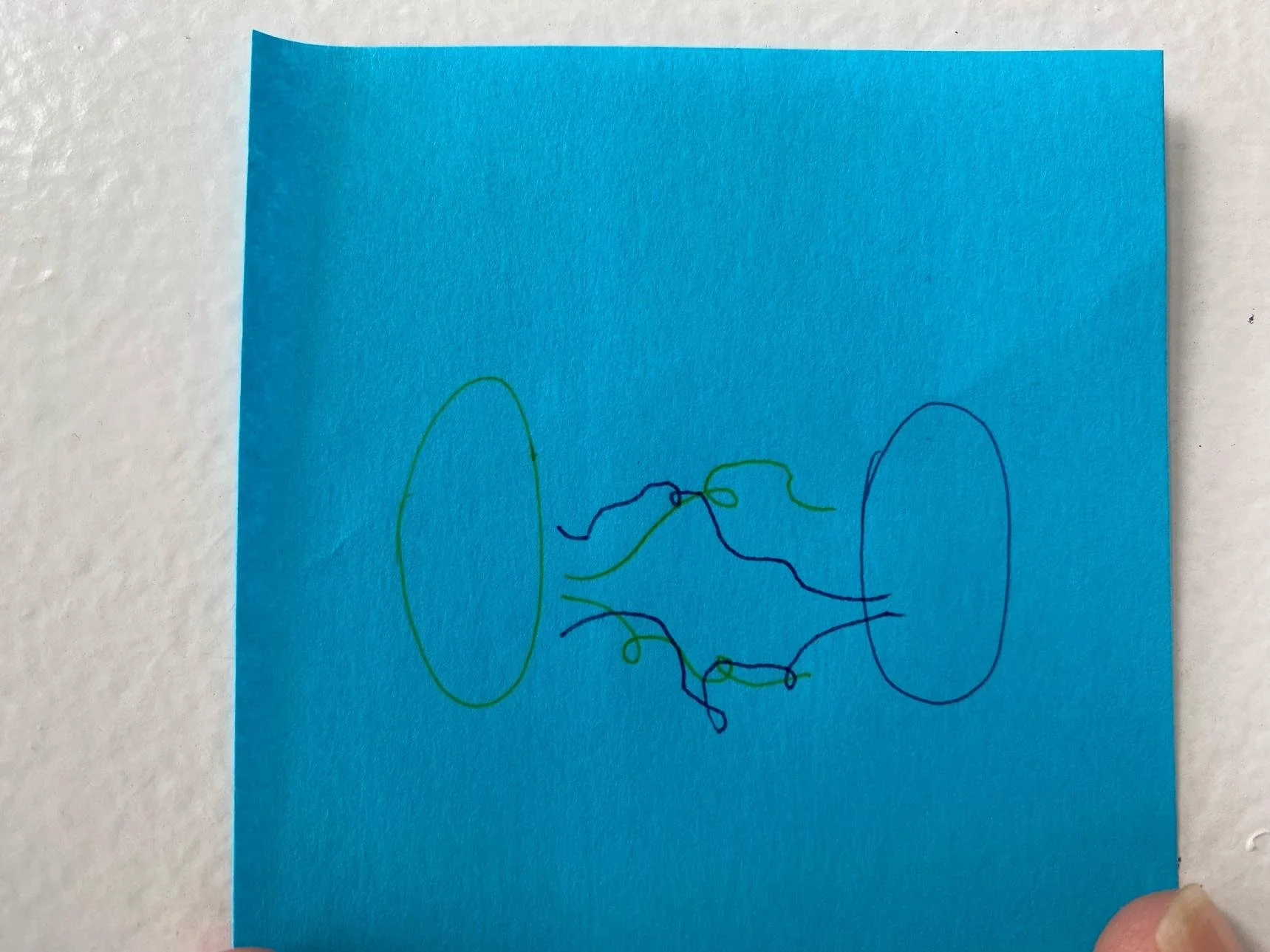
A visualization of feeling-relationality.
Works Cited:
Ahmed, S. (2014). The Cultural Politics of Emotion (2nd ed.). Edinburgh University Press.
Berlant, L. (2013). Cruel Optimism. De Gruyter.
Carolan, M. (2016). Embodied food politics. Routledge. https://doi.org/10.4324/9781315579139
Diatta, M. (2023). Undisciplining Who We Bring to the Academic Table. PARSE Journal. https://doi.org/10.70733/7363hfheydn4
Fiddes, N. (2004). Meat: A Natural Symbol. Taylor and Francis.
Highmore, B. (2017). Cultural Feelings: Mood, Mediation and Cultural Politics. Routledge.
Probyn, E. (2003). Carnal Appetites. Routledge. https://doi.org/10.4324/9780203361160
Amalie Scheel (she/her) is a PhD candidate at the Department of Digital Design and Information Studies at Aarhus University. Her doctoral project explores meat as a cultural object in Denmark through the different ways people attach feelings and meanings to it in everyday controversies. Methodologically, she is particularly interested in how creative practices like collaging and poetry writing can support and unsettle ethnographic understandings of everyday phenomena. A current running throughout her work is a persistent interest in how we interact with the world through our senses, alongside a critical-naive insistence on resisting academic moral judgment of the people we do research with and about. She holds an MSc in Information Studies and a BA in Aesthetics and Culture from Aarhus University.