
BY HOLLY HOFFMAN
When asked to “explain the sensation of touching a medieval manuscript,” ChatGPT takes a moment to first compliment me on my great question before launching into a detailed description of what an encounter with a medieval manuscript might feel like: you experience the small ripples and tiny pores on each page; the temperature (cool, at first) gradually warms under your fingertips; the leathery “whisper” of the paper; the faint raised lines of the scribe’s pigment (OpenAI). It’s difficult to find fault in this assessment especially since it pairs quite neatly with a direct quote from Bruce Holsinger’s monograph On Parchment, which reads: “Then we touched them, the pads of our fingers and thumbs separated by each folio. Our nerves discerned the gossamer thinness of fine vellum, the uneven thickness of the rougher parchments” (25). It’s not abnormal for a medieval book historian to wax poetic about the books they encounter, but this, in turn, teaches Large Language Model such as ChatGPT, Google’s Gemini, Claude, and Copilot, that every encounter with an old book is a glorious, romantic experience. And while it’s certainly true that there is wonder and “truth value” (Nolan 471) in touching a book that is over five hundred years old, there are many moments that are unexpected or even underwhelming––a brown page, undecorated; parchment marred by hundreds of years of wear; crumbling paper; pages riddled with wormholes, brown and blemished; cramped, unreadable script. These are not moments described by AI, but they are certainly important. Perhaps, the most important moments.
As an instruction librarian who has facilitated dozens of information literacy sessions focused on both AI and primary source pedagogy, I have begun to think about the ways in which universities can ground students’ experiences in the tangible and sensory, taking them––if only momentarily––away from a screen-bound and AI-dominated world that teaches users that there’s always an easily-provided answer. As more students turn to LLMs and AI as their first method of conducting research, we lose the ability to connect with information in a meaningful way. There’s is no need to commit facts to memory, only the road map that takes us to that information; AI always has a confident, quick answer, removing any doubt from the recipient that there might be something more. For a student who has yet to experience a special collections library or have the privilege of working hands-on with a medieval manuscript in class, the ChatGPT description might feel like enough: True enough. Believable enough. Close enough. As cultural memory historian Manovich writes: “The past is continuously erased. And later, its selected bits are brought back as curated and idealized images and experiences” (477). This is exactly what ChatGPT is doing––handfeeding us the perfect, curated idea of experiencing an old book.
Might manuscript studies be the answer to the AI problem? As Borland (2013) writes, “All medieval manuscripts come to us with secrets, secrets that often can only be accessed, if at all, by closer investigation of the materiality of the book” (98). What if all students were required to spend time with old books? Specifically, with those overlooked or underwhelming moments of fracture, damage, fragility, brokenness, or partiality that forces us to take a closer look at history? Looking primarily at the book as an object (and fault as an entry point) also eliminates a lot of barriers experienced by smaller institutions that don’t have extensive rare book collections.
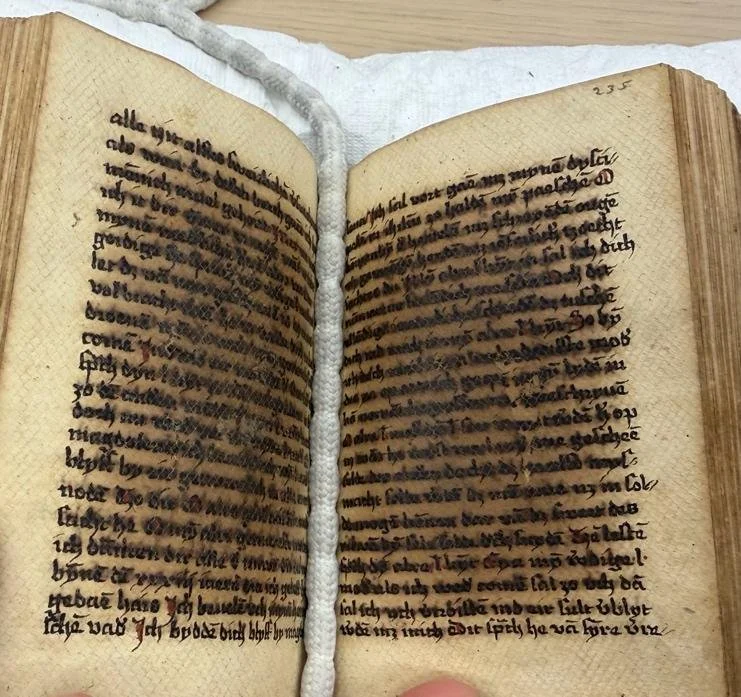
But why look at fault? Because these are the moments not easily “learned” by Large Language Models, and teach students about an independent world beyond human knowledge and intervention. A manuscript’s unique imperfections destabilize the notion that artificial “intelligence” always has the answer: in this, there is no right answer. Take, for example, the manuscript below. The image is from a 1568 German prayer book, handwritten on paper using a thick Gothic script. My first encounter with this manuscript is not the perfect, faultless experience ChatGPT promised me; I don’t experience the gradual warming of the pages. Maybe it’s because my hands are always cold? Instead, I’m met with the fear of accidentally destroying it. Pages are crumbling and brittle, and the ones that aren’t crumbling have been reinforced with clear rice paper, a common conservation method that can protect pages from further disintegration.
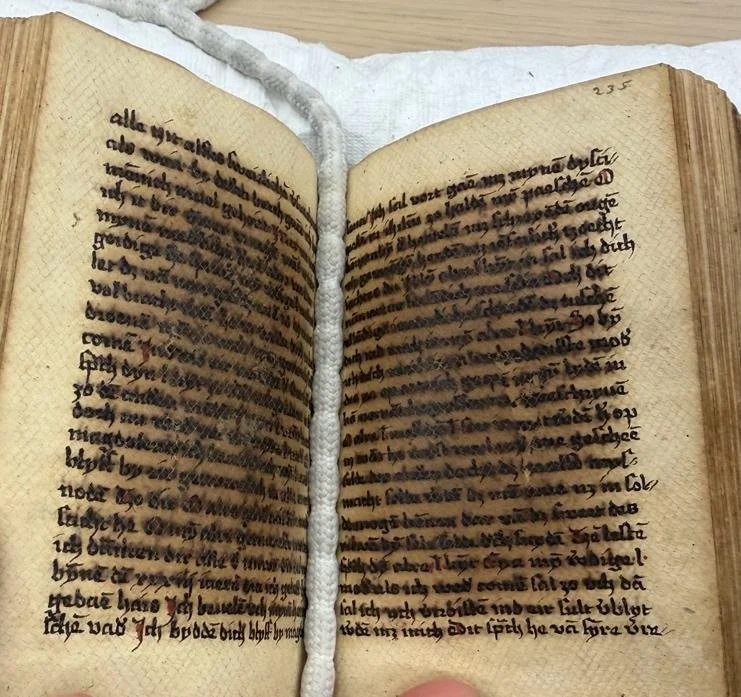
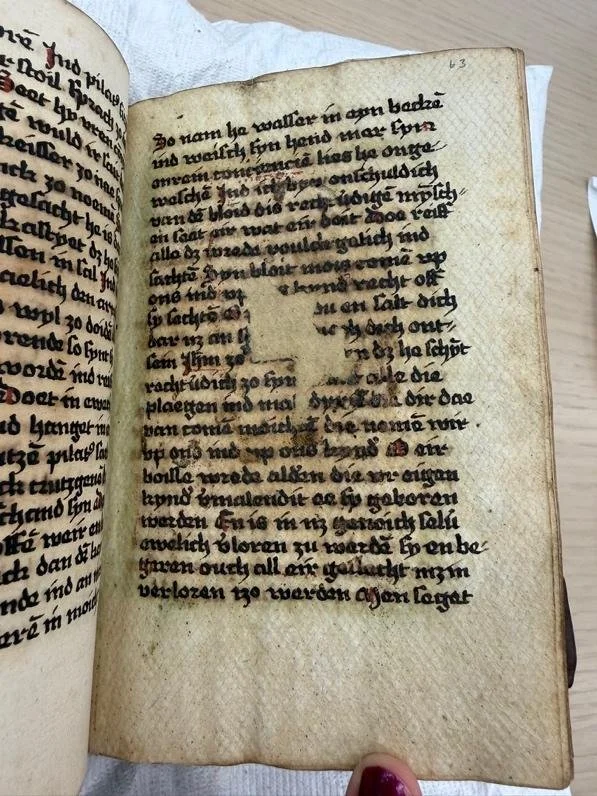
(BS2391568 TFDL ASC, University of Calgary)
The scattered notes I took while visiting the Archives and Special Collections say: “these pages are very rough” and “the rice paper is interesting. If you look through the wormholes, the pattern reminds me of a church.” The criss-crossed, lattice pattern of the rice paper is faint but, when a single page is held up to the light, you can see the delicate patterns that become visible through the damage, reminiscent of a rood screen or the stones of a medieval chapel. The correlation between the old, stone-coloured pages and the lattice pattern of the rice paper to a medieval church only happens because the paper is crumbling, not because of anything I have done. The book’s resistance demonstrates that it’s a vital force, acting on its own trajectory. Jane Bennett in Vibrant Matter describes these “material powers, which can aid or destroy, enrich or disable, ennoble or degrade us … call for our attentiveness, or even ‘respect’” (ix). What if we look at manuscripts through this lens, experiencing places of fault and damage as vital actants?
If students are exposed to medieval manuscripts, how might their understanding of the AI-mediated world around them change? According to Gottschling and Kramer, “Counteracting the information overload caused by AI is a challenging task. This is true as we move away from traditional concepts of authorship that have historically ensured reliable information” (17). Object-Oriented Ontology is a philosophical approach that puts actants other than humans at the forefront of our understanding of authorship, displacing the human (and the computer) by putting the ecology of fault in the forefront of authorship.
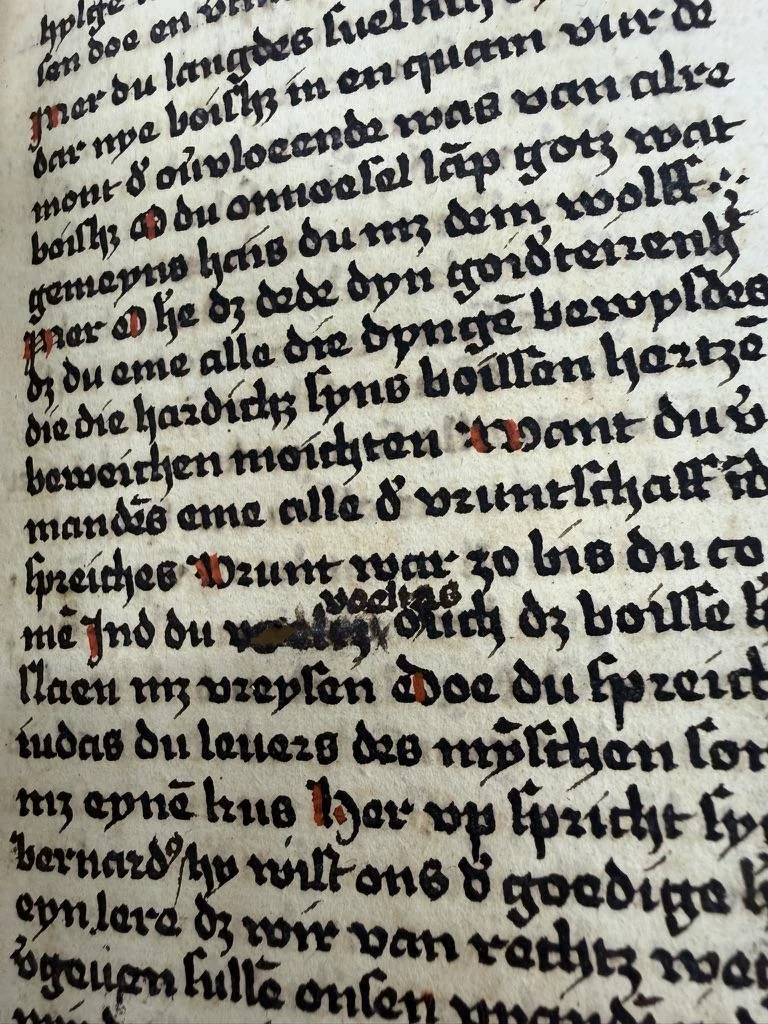
(ACC#15057, University of Calgary)
This second image is taken from a collection of sermons that belonged to an Italian mayor named Franciscus, de Mayronis in the 1400s. The manuscript is written in gothic hand on vellum, and while it’s in good condition, there are several pages with wormhole damage as evidenced by the image above in which someone tried to write around the hole. These flaws resist cultural and textual meanings by reminding us that there is more to the act of reading than simply understanding the words and the time it was produced. The manifestation of holes and blemishes suggest an element of control that the parchment has over the parchmenter. Humans try to turn skin into books, but the skin constantly reminds them it is not a book by disrupting our habitual reading practices with its imperfections. Moments of damage alert the modern reader to the book’s resistance. Not only does the book resist the scribe, but it also resists AI. While there is a future in which medieval manuscripts can be easily catalogued by LLMs to record places of damage and fault, these are still a place that cannot be easily discovered in the virtual world. Allowing students to experience the surprises and unanswerable questions that come from exploring manuscripts is paramount to ensuring that we don’t mistake digitization for complete access.
Not everything that matters about a book can be scanned, extracted, and categorized. Nothing can replace the experience of touching a physical book and experiencing the moments of fragility and wear that form independent from human intervention. As learning becomes ever more entangled with Generative AI, how might manuscripts be utilized––beyond the typical English and History classrooms––to encourage students to explore a world beyond their reach? Would manuscripts have a valid place in a biology classroom? What about philosophy? How might fault and damage encourage students to think of a world beyond the computer screen? Bringing manuscripts into classrooms could therefore offer an increasingly important form of learning, one grounded not only in what can be known, but in the uncertain and imperfect material encounter of what is unknown.
Works Cited
Bennett, Jane. Vibrant Matter: A Political Ecology of Things. Duke University Press, 2010. https://doi.org/10.2307/j.ctv111jh6w
Borland, Jennifer. “Unruly Reading: The Consuming Role of Touch in the Experience of a Medieval Manuscript.” Scraped, Stroked, and Bound, edited by Jonathan Wilcox, vol. 23, Brepols Publishers, 2013, pp. 97–114, https://doi.org/10.1484/M.USML-EB.5.100893
“Explain the sensation of touching a medieval manuscript” prompt. ChatGPT, model GPT-4o, OpenAI, 19 July 2026.
Gottschling, Markus, and Olaf Kramer. “Persuasive Surfaces and Calculating Machines. A Rhetorical Perspective on Artificial Intelligence.” Global Philosophy [Dordrecht], vol. 35, no. 3, June 2025, https://doi.org/10.1007/s10516-025-09748-3.
Holsinger, Bruce. On Parchment: Animals, Archives, and the Making of Culture from Herodotus to the Digital Age, Yale UP, 2023.
Manovich, Lev. “Unreliable Past: Constructing Memory with Generative AI.” Leonardo (Oxford) [One Rogers Street, Cambridge, MA 02142-1209, USA], vol. 58, no. 5, October 2025, pp. 477–83, https://doi.org/10.1162/LEON.a.95.
Nolan, Maura. “Medieval Habit, Modern Sensation: Reading Manuscripts in the Digital Age.” The Chaucer Review, vol. 47, no. 4, 2013, pp. 465–76, https://doi.org/10.5325/chaucerrev.47.4.0465
Holly Hoffman is an Information Literacy Librarian from Calgary, AB. She holds a MA in English Literature with a specialization in Medieval Studies, and a Masters in Library and Information Studies. Her academic interests encompass the interdisciplinary connection between book history, information literacy, and pedagogy.